

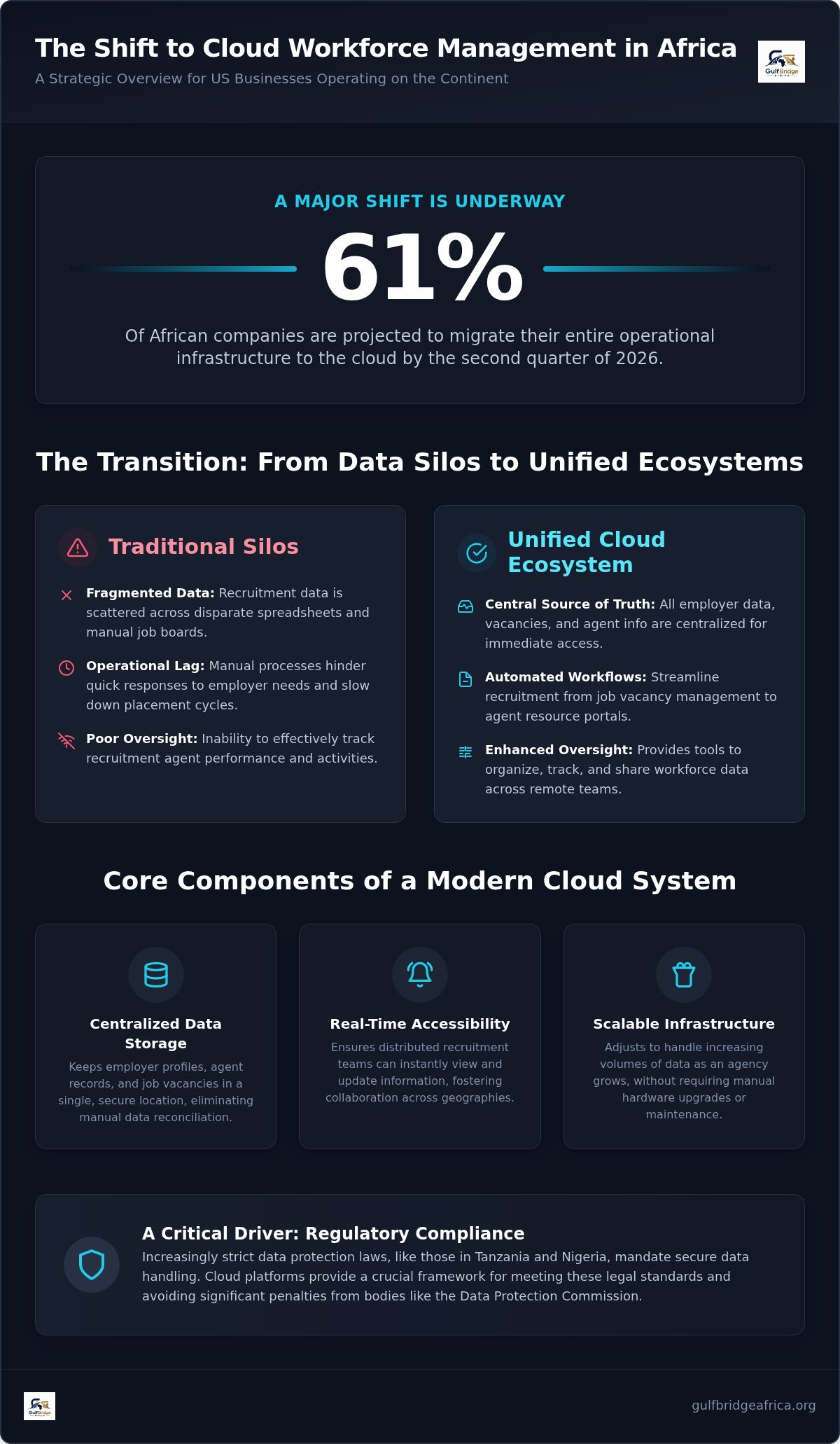
For US businesses looking towards the evolving landscape of global operations, understanding key regional trends is paramount. By the second quarter of 2026, a significant 61% of African companies are projected to migrate their entire operational infrastructure to the cloud. This strategic shift, particularly the adoption of cloud-based workforce management Africa systems, is a direct response to the increasing complexity of data protection laws in countries like Tanzania and Nigeria, where strict compliance deadlines now dictate the pace of business for any entity operating there. GulfBridge Africa recognizes that managing recruitment data across disparate spreadsheets and manual job boards often creates significant operational lag. Fragmented information hinders the ability to track recruitment agent performance or respond to employer needs quickly, challenges that are particularly acute for US firms with operations or clients across the continent.
This guide from GulfBridge Africa provides a functional analysis of how these systems centralize employer data and automate recruitment workflows, offering crucial insights for US companies. It focuses on the practical application of tools to improve organizational oversight and efficiency within the African context. You'll learn how to integrate job vacancy management with agent resource portals to create a single source of truth for your organization's operations across the continent. The following sections detail the systematic organization of employer data, the deployment of digital recruitment flyers, and the coordination of remote recruitment teams through a unified interface. This approach ensures that all operational components remain organized and accessible within a single digital environment, streamlining your cloud-based workforce management Africa initiatives.
Key Takeaways
- Transitioning from local spreadsheets to cloud-based systems improves operational oversight. This move centralizes employer data for immediate accessibility.
- Centralized databases allow for the systematic management of employer profiles and vacancy requirements. This organization reduces fragmented data across multiple platforms.
- Implementing cloud-based workforce management Africa solutions facilitates collaborative workflows between recruitment agents. Shared data ecosystems result in faster job placement cycles.
- Standardized data entry protocols ensure consistent data handling across remote teams. Establishing these protocols simplifies the migration from manual processes.
- A unified interface provides tools for organizing, tracking, and sharing workforce data. This platform serves as a reliable framework for systematic task management.
Understanding Cloud-Based Workforce Management in Africa
Cloud-based workforce management Africa refers to the use of remote digital infrastructure to organize recruitment and manpower operations. It replaces local storage methods with a centralized online environment. Agencies use these systems to manage employer data, job postings, and recruitment agent workflows. This operational shift removes the limitations of local spreadsheets. It ensures that every team member accesses the same version of a file at all times. Centralization creates a reliable framework for data handling and professional oversight.
Regional adoption is increasing rapidly due to new regulatory requirements. By 2026, 61% of companies in the region intend to migrate their operations to the cloud. This trend is driven by strict data protection laws. For instance, Tanzania's Data Protection Authority mandated a registration deadline of April 8, 2026. In Nigeria, the Data Protection Commission began issuing formal investigation notices in early 2026 to address data breaches. SaaS platforms allow agencies to meet these legal standards without investing in on-premise hardware. They provide a secure environment that aligns with modern compliance protocols.
SaaS platforms also lower IT overhead by removing the need for local server maintenance. The platform provider manages security updates and system backups automatically. This allows agency staff to focus on operational tasks rather than technical troubleshooting. It reduces the financial burden of maintaining a dedicated IT department. The system stays current without manual intervention from the user.
The Core Components of Modern Cloud Systems
Modern cloud systems provide the framework for systematic data handling. They include three essential elements for manpower agencies. Centralized data storage keeps employer profiles and recruitment agent records in a single location. This eliminates the need for manual data reconciliation. Real-time accessibility ensures that distributed recruitment teams can view and update job vacancies instantly. Scalable infrastructure allows the platform to handle increasing volumes of data as an agency grows. It adjusts to the user's requirements without requiring manual hardware upgrades.
Operational Benefits for African Agencies
Adopting a cloud-based approach reduces administrative errors. Data redundancy often occurs when multiple recruiters maintain separate spreadsheets. A centralized system prevents this by creating a single record for each entry. This improves oversight of recruitment agent activities. Managers can track agent progress and performance within the platform interface. These systems also enhance the ability to respond to global job market demands. Quick access to organized data allows for faster candidate matching and job placement. The result is a more efficient recruitment cycle that supports regional business expansion.
Managing Multiple Data Types in a Unified System
Recruitment agencies handle diverse data sets daily. These include employer requirements, agent contact lists, and marketing collateral. A cloud-based workforce management Africa system provides the structure needed to consolidate these files. Centralization prevents the loss of critical information during high-volume hiring cycles. It replaces fragmented storage with a single, searchable environment. Managing these data types in isolation leads to redundancy. A unified system ensures that an update to an employer profile is reflected across all related job postings instantly.
Employer Data Management and Organization
Systematic organization begins with detailed employer profiles. Agencies should categorize data by industry sector and specific vacancy requirements. This categorization allows for rapid retrieval when matching candidates to roles. Standardized record-keeping is now mandatory for regional compliance. For example, Burundi adopted a new Data Protection Law on January 15, 2026. Agencies must ensure their digital archives meet these legal standards for data mapping. Record-keeping also involves tracking communication logs and contract terms. Systematic archiving ensures that all agreements are accessible during audits. This is particularly relevant in Mauritius, which launched its National Data Strategy for 2025 to 2029. Such frameworks emphasize the importance of data integrity in professional services. Maintaining historical data helps track long-term employer relationships and previous hiring patterns. This historical oversight informs future resource allocation.
Agent Resource Portals and Collaboration
Recruitment agents need immediate access to updated operational tools. An agent resource portal serves as a central hub for sharing job specifications and recruitment flyers. This ensures all agents use current marketing materials. You can monitor agent progress through systematic status tracking within the platform. This oversight identifies bottlenecks in the recruitment pipeline. It eliminates the need for manual check-ins across different time zones. Agencies looking to streamline these processes can utilize a structured platform for employer data management to maintain operational order. The system records every interaction, providing a clear audit trail for management review.
Digital assets are integrated directly into the recruitment workflow. Agents download recruitment flyers from the portal instead of receiving them via email. This maintains consistency and ensures data accuracy across all channels. Tracking the distribution of these resources provides insight into agent activity levels. The use of digital recruitment flyers allows for a modular approach to job marketing. Agencies can update job details in the central database and see those changes reflected in the assets available to agents. This real-time synchronization reduces the risk of agents promoting outdated or filled positions. It ensures that the recruitment pipeline remains accurate and functional. It creates a predictable rhythm for task completion and reporting.
Analyzing the Transition: Silos vs. Collaborative Ecosystems
Siloed recruitment data limits operational speed. Many agencies in Africa currently use disconnected spreadsheets and email chains. This fragmentation creates delays in job placements. A cloud-based workforce management Africa system integrates these silos into a single ecosystem. It allows recruitment teams and employers to view identical data simultaneously. This transparency reduces the need for constant status updates. It creates a more responsive environment for manpower management. Real-time data sharing improves the accuracy of operational decision-making. Managers see which vacancies are filled and which require more resources immediately. This oversight prevents the duplication of effort across different departments.
Comparing Traditional and Cloud-Based Workflows
Traditional workflows rely on email-based data exchange. This method often results in version control issues. Cloud systems provide shared database access. Every team member works from the same master file. Traditional agencies manually update job boards, which is a slow process. Cloud platforms offer automated vacancy listings. A single entry updates multiple channels instantly. Traditional physical record storage is vulnerable to damage and unauthorized access. Cloud-based systems use encrypted digital archives. These archives meet the requirements of the 45 African countries that have enacted data privacy laws as of 2026. For example, the Republic of Congo inaugurated its National Personal Data Protection Commission on December 31, 2025. Digital encryption ensures that agencies comply with these emerging regulatory frameworks. You don't have to worry about data loss when using a systematic digital archive.
The Role of Job Posting Portals
Job posting portals streamline the publication of vacancies. They allow agencies to broadcast opportunities to various platforms from one dashboard. This centralization manages applicant flow through a standardized administrative interface. Recruiters track every stage of the candidate journey without switching applications. The portal also integrates recruitment marketing flyers into the posting process. Agents access these flyers directly within the workflow. This ensures that all promotional materials align with the latest job specifications. Integrating these tools reduces the time spent on administrative coordination. It allows teams to focus on matching candidates to employer needs. Real-time data sharing ensures that decisions are based on current market conditions. This systematic approach supports faster hiring cycles and more reliable placement results. It provides a structured method for handling high-volume recruitment tasks.
Implementation Framework for African Manpower Agencies
Implementing a cloud-based workforce management Africa system requires a structured transition plan. You must first assess current data structures. Identify which legacy records are active and which are redundant. Prioritize the migration of current employer profiles and open job vacancies. Establishing standardized data entry protocols ensures that all team members input information consistently. This consistency is necessary for accurate reporting and automated workflows. A clear framework prevents the duplication of effort during the setup phase.
Data Migration and System Configuration
Cleaning legacy data is the first functional step. Remove duplicate entries and correct formatting errors before importing files into the cloud database. You don't want to import inaccurate data during this phase. Mapping data fields ensures that information from your old spreadsheets aligns with the new platform's categories. You should configure the system to match your agency's specific hierarchy. Once the configuration is complete, test the workflow with a pilot recruitment campaign. This pilot phase identifies any gaps in the data mapping or user interface before full-scale deployment. It allows for adjustments in a controlled environment.
Maintaining Operational Security and Compliance
Operational security relies on role-based access control. You must configure user permissions to restrict sensitive employer data to authorized personnel only. Using a cloud-based workforce management Africa solution allows for granular control over who views specific datasets. Recruitment agents should have access to job specifications and recruitment flyers but not to internal financial records. Regular system audits ensure that team members adhere to established protocols. Compliance with regional data protection acts is a mandatory requirement. For instance, Eswatini set a deadline of March 31, 2026, for the submission of all data maps. Tanzania's Data Protection Authority required organizations to complete registration by April 8, 2026. Non-compliance in these jurisdictions leads to sanctions. A systematic cloud platform provides the oversight needed to meet these deadlines.
Staff training focuses on systematic data management. Team members must understand how to use tracking features to update candidate statuses and agent progress. This training reduces the risk of administrative errors during high-volume hiring periods. Standardized training ensures that every user understands the primary purpose of each platform section. You can access our employer data management platform to begin organizing your agency's operational data. This transition moves your agency from manual oversight to a structured digital environment. It creates a predictable rhythm for daily recruitment tasks and ensures long-term operational stability.
GulfBridge Africa: A Systematic Tool for Workforce Data
GulfBridge Africa is a SaaS platform designed for the systematic management of workforce data. It provides the digital infrastructure needed to organize employer profiles, job postings, and recruitment agent resources. The platform addresses the operational gaps found in fragmented systems by consolidating all workflows into a single environment. Using a cloud-based workforce management Africa system allows agencies to maintain oversight of complex data sets without increasing administrative overhead. The interface is built for professional data handling and team coordination. It functions as a silent partner in the agency's daily operations.
Integrated tools for Job Posting and Recruitment Flyers are core components of the system. These features allow for the immediate distribution of vacancy details to recruitment agents. The Agent Resource Portal serves as a central hub where agents access standardized job specifications. This ensures that all regional recruitment efforts remain consistent and accurate. The system tracks every interaction within the portal, providing a clear audit trail for management review. It removes the need for manual checks and reduces the risk of data redundancy. It's a structured approach to data handling that ensures all promotional materials align with current employer requirements.
Streamlining Agency Operations
The platform provides a single interface for diverse administrative tasks. Users manage employer profiles and vacancy requirements from one dashboard. This facilitates collaboration between internal recruitment teams and external agents. Information is shared instantly, removing the need for manual status reports. You can access these data management tools from any location with an internet connection. This supports remote work and regional expansion across African business hubs. The system maintains a consistent rhythm for task management. It ensures that every team member follows the same operational logic. This structure brings order to the professional environment and simplifies complex hiring cycles.
Next Steps for Platform Adoption
Agencies select a subscription model based on their specific volume and data storage requirements. This ensures the service scales with the organization's growth. Once the account is active, you can utilize the job listing service for all active recruitment needs. This service automates the publication of vacancies to multiple channels. For detailed system implementation support, agencies contact GulfBridge Africa directly. The support team provides guidance on setting up user permissions and mapping legacy data. This ensures that the migration from legacy systems follows the established framework for data integrity and compliance. Following these steps allows for a smooth transition to cloud-based workforce management Africa. It establishes a reliable foundation for long-term operational efficiency and systematic data oversight.
Establishing Operational Efficiency for African Manpower Agencies
Transitioning to cloud-based workforce management Africa ensures that recruitment agencies maintain a competitive edge in an increasingly regulated market. Centralizing employer data and agent resources removes the inefficiencies of manual record-keeping. You've seen how systematic data mapping supports compliance with the 2026 mandates in Tanzania, Nigeria, and Eswatini. Shifting from disconnected email chains to a unified digital environment creates a reliable framework for sustainable growth.
Utilizing a Centralized Employer Database, Agent Resource Portal, and Integrated Job Listing Tools allows for precise oversight of the recruitment pipeline. These features provide the structure necessary to manage high-volume hiring cycles without administrative errors. You can Access the GulfBridge Africa Data Management Platform to begin organizing your operational workflows today. Adopting these systematic tools prepares your agency for the future of regional labor migration management. Progress starts with a structured digital foundation.
Frequently Asked Questions
What is cloud-based workforce management and how does it work?
Cloud-based workforce management Africa systems function as digital hubs for organizing recruitment operations. These platforms host employer data, job vacancies, and agent workflows on remote servers accessible via the internet. Users update records in a centralized environment, ensuring that all team members access the same information in real-time. This systematic approach replaces fragmented local storage with a structured digital interface. It provides a reliable framework for managing the entire recruitment lifecycle from a single location.
Is employer data secure in a cloud-based recruitment platform?
Employer data is secured through encrypted digital archives and granular role-based access control. These security measures align with regional laws, including the 2026 data protection mandates in Tanzania and Nigeria. Agencies configure user permissions to restrict access to sensitive information, ensuring only authorized staff view specific datasets. Regular system audits maintain protocol adherence across the organization. This systematic oversight protects data integrity and ensures compliance with evolving African data privacy standards.
Can recruitment agencies in Africa use these tools for global placements?
Agencies utilize these tools to coordinate with international employers and remote recruitment agents across different time zones. The platform manages diverse jurisdictions, currencies, and compliance requirements within a unified dashboard. Real-time data sharing allows distributed teams to collaborate on global placements without operational delays. This is essential for agencies connecting African workers with employers in the Gulf region. The system provides a structured environment for tracking candidate progress throughout the international hiring cycle.
How does a job posting portal improve the recruitment process?
A job posting portal automates the distribution of vacancies to multiple digital channels from one administrative interface. This centralization eliminates the need for manual updates on individual job boards. It standardizes the applicant flow, allowing recruiters to track candidate stages systematically. Integrating digital recruitment flyers into the portal ensures that all marketing materials align with current job specifications. This streamlined process reduces administrative time and improves the speed of the recruitment cycle.
What data types can be managed within the GulfBridge Africa platform?
The platform manages multiple data types including detailed employer profiles, specific vacancy requirements, and recruitment agent records. It also organizes digital assets like marketing flyers and communication logs. Historical data is archived to maintain long-term oversight of employer relationships and past hiring patterns. This systematic organization ensures that all operational information remains searchable and accessible. It creates a single source of truth for the agency's internal teams and external recruitment partners.
Do I need specialized hardware to use cloud-based management software?
Specialized hardware is not required for cloud-based workforce management Africa platforms. Because the system operates as a SaaS model, users access it through standard web browsers on existing devices. This removes the financial burden of purchasing and maintaining local servers. The platform provider manages all backend technical tasks, including security patches and system backups. This setup reduces IT overhead and allows agency staff to focus on task management and operational efficiency.
How do recruitment flyers help in agency marketing campaigns?
Recruitment flyers serve as standardized marketing assets that agents use to promote specific job vacancies. These digital tools ensure that all promotional messages remain consistent and accurate across different recruitment channels. Agents download current flyers directly from the resource portal, which prevents the use of outdated job details. Tracking the distribution of these flyers provides insight into agent activity and campaign performance. This systematic approach ensures that recruitment marketing remains professional and organized.
What are the costs associated with cloud-based workforce platforms?
Costs are structured through subscription models that scale according to an agency's data storage and user requirements. This approach allows agencies to pay for the specific capacity they need to manage their current recruitment volume. The primary costs cover access to the centralized database, job posting services, and agent resource portals. Agencies don't face the high upfront expenses associated with custom on-premise software. Evaluating active recruitment needs helps in selecting a cost-effective subscription model.


