

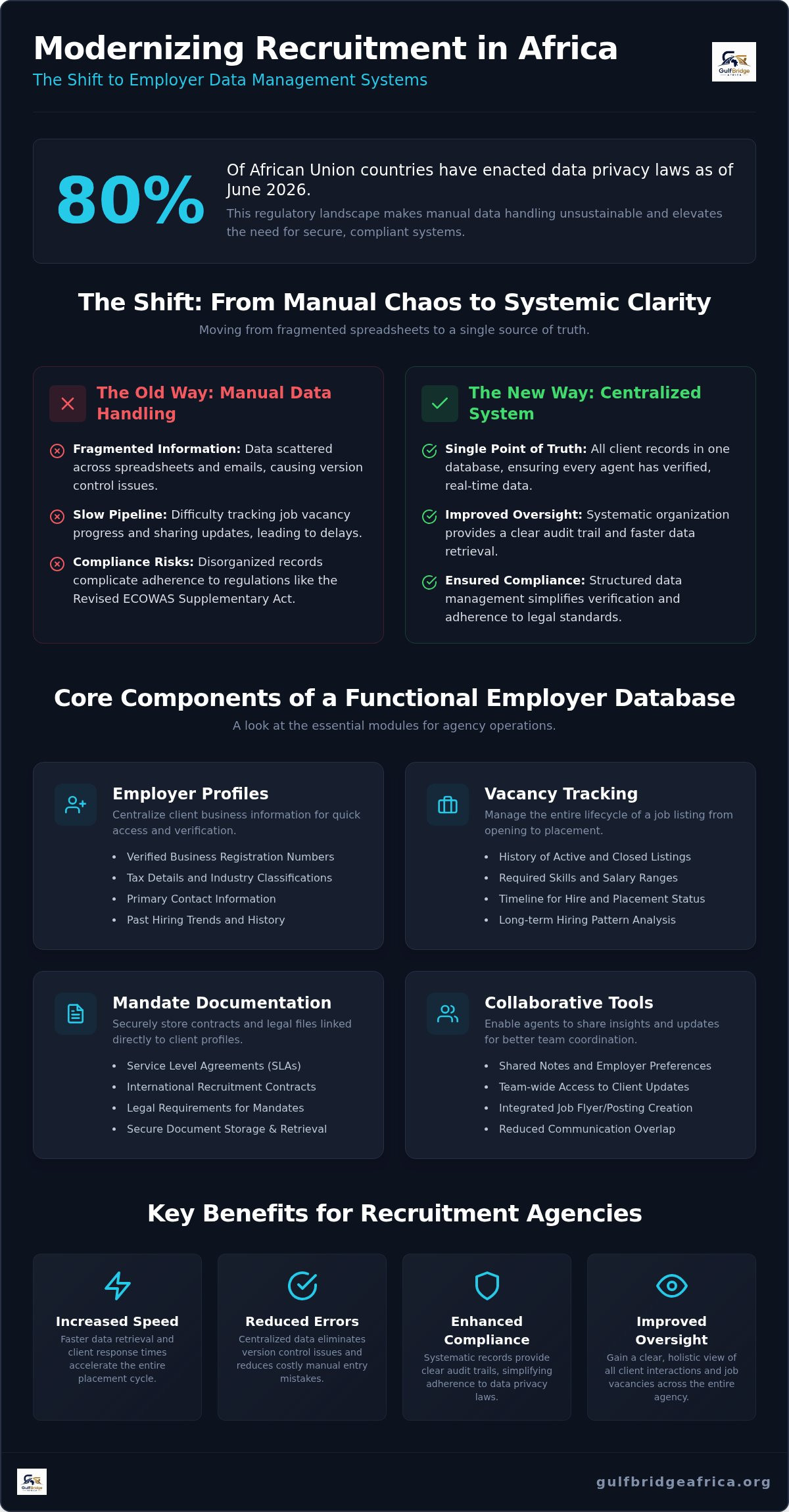
As of June 2026, 80% of African Union countries have enacted specific data privacy laws. This statistic confirms that manual data handling is no longer a sustainable practice for recruitment agencies. Recruitment teams often manage employer information scattered across various spreadsheets and email threads. This fragmentation makes it difficult to track job vacancy progress. This fragmentation also makes it difficult to share updates within the team. Implementing a dedicated employer data management system addresses these operational gaps by providing a single point of truth for all client records.
It's clear that disorganized data slows down the recruitment pipeline and complicates compliance with regulations like the Revised ECOWAS Supplementary Act. This guide explains how to systematically organize, track, and secure employer information. You'll learn how to build a centralized database. You'll learn how to improve oversight. You'll learn how to streamline job vacancy management. We'll outline the practical steps to move an agency toward a more structured and collaborative workflow. This transition ensures every agent has access to the same verified data. This access reduces errors. This access also increases placement speed across the African market.
Key Takeaways
- Define the role of an employer data management system in centralizing fragmented client records for improved agency oversight.
- Identify the core components of employer profiles and job vacancy modules necessary for systematic data tracking.
- Select recruitment platforms based on cloud-based accessibility and scalability for cross-border operations within Africa.
- Establish standardized data entry protocols and security permissions to ensure consistent information handling among agency staff.
- Use integrated tools to streamline the creation of recruitment flyers and job postings for better team coordination.
What is an Employer Data Management System?
An employer data management system is a specialized database designed to centralize information regarding a recruitment agency's clients. This differs from a standard Human Resource Management System, which typically focuses on internal employee records like payroll and performance reviews. For agencies, the focus remains external. The system tracks the businesses that provide job vacancies rather than the agency's own staff. It acts as a single repository for all employer-related data. This includes contact details, past hiring trends, and specific industry requirements. Using a centralized system reduces data fragmentation. It ensures every agent in the firm accesses the same verified information.
Operational clarity improves when agencies move away from siloed information. Faster data retrieval allows agents to respond to employer requests immediately. Systematic organization reduces the risk of lost records. It provides a clear audit trail for every interaction between the agency and the employer. This level of oversight is essential for maintaining professional standards and improving placement speed.
The Shift from Spreadsheets to Systematic Databases
High-volume recruitment requires speed and accuracy. Manual data entry in spreadsheets often leads to version control issues. One agent might update a file while another uses an outdated copy. This inconsistency creates delays and errors. Cloud-based storage is now a requirement for regional agencies operating across Africa. It allows teams in different locations to sync data in real time. Automated record organization removes the need for manual filing. This reduction in administrative overhead lets agents focus on placement tasks rather than data entry. It's a move toward a more predictable and scalable business model.
Core Functions for Recruitment Agencies
Recruitment agencies require specific data points to manage their mandates effectively. A functional employer data management system must handle diverse data types to remain useful. The primary functions include:
- Employer Profiles: Centralizing business registration numbers, tax details, and primary contact information.
- Vacancy Tracking: Maintaining a history of active and closed job listings for every client business.
- Mandate Documentation: Storing contracts and legal requirements for international recruitment mandates.
Managing these elements in one place simplifies the tracking of international mandates. Agencies can quickly verify whether an employer has the necessary legal standing to hire workers. This systematic approach ensures compliance and improves the reliability of the recruitment process. It builds a foundation for long-term client relationships through organized and professional data handling.
Core Components of a Functional Employer Database
A functional employer data management system requires specific modules to handle the complexities of agency operations. The first component is the employer profile. This profile includes verified business registration numbers and precise industry classifications. These fields serve as the foundation for reporting and compliance checks. Agencies use these details to ensure that a client is authorized to operate in specific sectors. This verification step is critical before starting any recruitment mandate.
The second component is the job vacancy management module. This feature tracks the lifecycle of a listing from opening to placement. It records the specific skills required, the salary range offered, and the timeline for hire. Tracking closed listings is just as important as tracking active ones. It provides a record of successful placements and helps identify long-term hiring patterns. This historical data allows agencies to predict future needs for recurring clients.
Document storage is the third essential component. Recruitment agencies handle sensitive service level terms and recruitment agreements. Storing these documents within the employer data management system ensures they're linked directly to the client's profile. This setup simplifies contract renewals and dispute resolution. Finally, collaborative tools enable agents to share insights and updates. When an agent learns a new detail about an employer's preference, they enter it into the system for the whole team to see. This transparency reduces the risk of overlapping communications or missed updates.
Organizing Employer Information Online
Structuring data fields for quick search and filtering improves operational speed. Agencies should categorize employers by region, industry, or recruitment volume. This allows agents to filter for specific categories in seconds. Maintaining data consistency across multiple agency branches is a common challenge. Standardized entry protocols ensure that an employer record created in one office is identical in format to one created in another. This uniformity is vital for accurate cross-branch reporting and data analysis.
Managing Multiple Employer Data Types
Agencies must handle diverse requirements for local versus international employers. International mandates often involve complex labor migration laws and specific documentation. The system must accommodate these extra files without cluttering the interface. Integrating recruitment marketing assets, such as digital flyers, directly into the employer record streamlines the outreach process. Tracking employer-specific communication logs and updates prevents agents from asking redundant questions. Using an employer data management platform allows agencies to organize these diverse data types within a single, secure environment. This systematic approach ensures that no detail is lost during the recruitment lifecycle.
Evaluating Recruitment Systems for the African Context
Selecting an employer data management system requires a focus on regional operational realities. African agencies often manage recruitment mandates that span multiple countries. This is particularly true for agencies serving the African-Gulf recruitment corridor. A system must handle high volumes of data without sacrificing speed. It needs to provide a stable environment for tracking hundreds of employer vacancies simultaneously. Reliability is the primary metric for success in these environments.
Scalability ensures that the system grows alongside the agency's client list. An agency managing five employers has different needs than one managing fifty. The database structure must remain organized regardless of the data volume. This organization allows for rapid scanning and decision-making. Collaborative workflows are also essential. Agents in different geographic regions must access the same data points to avoid duplication of effort. This shared access creates a unified operational front for the agency.
Cloud-Based Workforce Management in Africa
Infrastructure challenges often hinder local data storage solutions. Reliable cloud platforms overcome these hurdles by hosting data on secure, remote servers. This setup enables remote access for field agents and branch offices. An agent in a rural district can upload employer requirements as easily as an agent in a capital city. Centralized data provides regional oversight for agency directors. They can monitor vacancy progress across all branches from a single dashboard. This visibility is crucial for maintaining compliance with the Revised ECOWAS Supplementary Act and other regional data frameworks. As of June 2026, 80% of African Union countries have enacted data privacy laws. This makes cloud security a necessity for legal operations.
Agency-Specific Features to Prioritize
Generic HR software often lacks the tools necessary for recruitment agencies. Prioritize systems that offer built-in job posting portals for employer clients. These portals allow employers to view the status of their vacancies in real time. An agent resource portal is another critical feature. It serves as a central hub for documentation, training materials, and legal updates. This ensures all agents follow the same standardized procedures. It's an essential tool for maintaining a professional register across a distributed workforce.
Tools for generating and managing recruitment flyers are also vital. These flyers act as marketing assets for specific job listings. Integrating these assets directly into the employer data management system streamlines the recruitment process. It allows agents to deploy marketing materials immediately after a vacancy is registered. This integration reduces the time between a client request and active recruitment. Using these specialized features ensures the agency operates with maximum efficiency and systematic logic.
Implementation and Best Practices for Data Handling
Standardizing data entry protocols is the first step in maintaining a clean database. Agency staff must follow specific naming conventions for every employer profile. They must use standardized industry codes. This uniformity allows for accurate filtering across the entire agency. It prevents the creation of duplicate records. Data entry becomes a predictable administrative task rather than a source of confusion. Systematic input ensures that the database remains a reliable asset for long-term operations.
Establishing clear access permissions prevents unauthorized data exposure. Not every agent needs access to every employer contract or service level agreement. The system should allow for role-based access controls. Administrative users define these roles based on the agent's seniority or specific mandate assignments. Regular audits ensure the database remains relevant and accurate. Data rot occurs when contact details change or businesses close. Quarterly reviews help identify and remove obsolete records. This process maintains the integrity of the employer data management system.
Training recruitment agents on systematic platform usage is essential. Agents must understand the logic of the platform to use it effectively. They need to know how to utilize search filters. They need to know how to upload mandate documents correctly. Consistent training reduces errors. It also ensures that the team uses the platform to its full potential. To begin organizing your agency records, implement a professional employer data management platform today.
Employer Data Sharing and Collaboration
Shared workspaces facilitate specific recruitment campaigns. Multiple agents can work on a single employer mandate without duplicating effort. The system tracks every update made to a record. This creates a clear audit trail for management oversight. Managing agent permissions protects employer confidentiality. This is vital when handling sensitive client lists. A centralized platform eliminates data redundancy. It ensures that only one verified version of an employer record exists at any time.
Data Security and Regional Compliance
Security is mandatory in cloud environments. Agencies must comply with the Revised ECOWAS Supplementary Act adopted on July 19, 2026. This act mandates stronger data governance and cybersecurity measures for cross-border data transfers. In Nigeria, the General Application and Implementation Directive requires reporting data breaches within a strict 72-hour window. In South Africa, non-compliance with the Protection of Personal Information Act carries fines of up to R10 million. Protecting sensitive employer information is a legal requirement. Developing backup and recovery procedures is a critical operational step. Agencies should verify that their cloud provider maintains redundant storage. This protects agency records from local hardware failures or regional connectivity issues.
GulfBridge Africa: Integrated Data and Job Management
GulfBridge Africa provides a cloud-based platform designed specifically for the administrative needs of recruitment agencies. This employer data management system centralizes client records, job listings, and agent resources into a single interface. Agencies use the platform to organize multiple data types without the risk of information silos. The system architecture prioritizes operational speed. It allows for the rapid retrieval of employer profiles and contract details. This systematic approach ensures that agency directors maintain full oversight of their recruitment pipeline.
The integrated job posting portal facilitates the entire vacancy lifecycle. Agents register new job listings directly within the employer record. This connection ensures that every vacancy is linked to a verified client profile. The platform handles high volumes of listings, making it suitable for agencies managing hundreds of employer vacancies. By using a centralized tool, agencies eliminate the need for external tracking sheets. This integration reduces errors. It also ensures that job data remains consistent across all branch offices.
Recruitment marketing assets are also managed within the platform. Agents use the digital recruitment flyer feature to generate promotional materials for specific mandates. These flyers are linked to active job postings, ensuring that marketing efforts align with real-time data. The specialized agent resource portal provides a central hub for training and documentation. This portal ensures that all team members follow standardized protocols for data handling and employer communication. It serves as a silent, reliable partner in the daily agency workflow.
Streamlining Agency Operations
Organizing, tracking, and sharing work in a single interface improves team coordination. GulfBridge Africa centralizes workforce data for both large teams and solo recruitment users. This centralization removes the friction associated with fragmented email threads. Systematic logic guides the user through each organizational step. This structure reduces the time spent on repetitive administrative tasks. Agents focus on placement outcomes while the platform manages the underlying data organization. The result is a more efficient and predictable operational environment.
Next Steps for African Recruitment Agencies
Agencies should begin by assessing their current data management gaps. Identify where data redundancy occurs. Determine which processes require better oversight. Moving to a centralized system is a logical step toward regional scalability. Registering for platform access allows agencies to begin the data centralization process immediately. This transition secures employer records and improves collaborative workflows across geographic regions. Optimize your agency data with GulfBridge Africa to establish a professional and systematic foundation for your recruitment operations.
Operationalizing Agency Data for Regional Growth
Centralizing employer records is the primary method for managing high-volume recruitment mandates. Systematic data handling removes the administrative friction caused by fragmented spreadsheets. When agents use a single repository, they spend less time searching for verified information. They spend more time on placement tasks. This operational shift improves both speed and accuracy across the agency. It ensures that all team members work from the same data set. This consistency is vital for maintaining professional standards in the African recruitment sector.
Transitioning to a dedicated employer data management system provides the oversight necessary for cross-border operations. GulfBridge Africa offers cloud-based organization for recruitment teams. The platform includes integrated job posting services and a specialized agent resource portal. These features ensure that every agent follows standardized protocols regardless of their location. It's a practical solution for agencies that value organization and streamlined processes. This structure allows your firm to scale without losing data integrity.
Access the GulfBridge Africa Data Management Platform to begin centralizing your client records. Establishing a structured database today builds a reliable foundation for the future of your recruitment agency.
Frequently Asked Questions
What is an employer data management system for recruitment agencies?
An employer data management system is a specialized digital repository for storing and organizing information about business clients. It centralizes business registration details, industry classifications, and contact information. This system differs from internal HR tools by focusing on external client mandates rather than internal payroll. Agencies use these systems to track hiring history and contractual terms. This organization provides a single source of truth for the entire recruitment team.
How does a centralized database improve recruitment efficiency?
A centralized database improves efficiency by eliminating data fragmentation across multiple spreadsheets and email threads. Agents spend less time searching for employer requirements and more time on placement tasks. Standardized records ensure that every team member accesses the same verified information. This reduces the risk of redundant communication with employers. Faster data retrieval leads to shorter response times. Shorter response times increase the overall speed of the recruitment cycle.
Can I manage international employer data on a cloud platform?
You can manage international employer data effectively using a cloud-based platform. Cloud systems enable real-time data syncing across different geographic regions and branch offices. This is essential for agencies managing mandates in the African-Gulf recruitment corridor. Agents in different countries can access the same employer profiles and job vacancy logs. This shared access ensures that international recruitment mandates follow consistent protocols. It also allows for centralized oversight of cross-border placement progress.
Is cloud storage secure for sensitive recruitment agency data?
Cloud storage is secure when the system utilizes role-based access controls and encrypted servers. Modern platforms comply with regional regulations like the South African POPIA and the Revised ECOWAS Supplementary Act. These frameworks mandate strict data protection and breach notification protocols. Security measures include redundant backups to protect against local hardware failure. Establishing clear permissions ensures that only authorized agents view sensitive data. This systematic approach reduces the risk of breaches within the employer data management system.
What features are essential for a manpower agency management software?
Essential features include employer profiles, job vacancy management modules, and document storage for recruitment agreements. A functional manpower agency management software should also offer an agent resource portal. This portal centralizes training materials and legal updates. Built-in job posting tools allow for the immediate registration of new vacancies. These features work together to create a streamlined workflow. This workflow supports both solo recruitment users and large, distributed agency teams.
How do digital recruitment flyers integrate with data management?
Digital recruitment flyers integrate with data management by pulling information directly from active job vacancy records. When an agent registers a new vacancy, the system generates a flyer using the stored requirements. This integration ensures that marketing assets are accurate and up to date. It removes the need for manual design tasks. Agents can deploy these flyers to candidate pools immediately after a client confirms a mandate. This linkage speeds up the initial outreach phase.
Can multiple agents collaborate on the same employer profile?
Multiple agents can collaborate on the same employer profile through shared workspaces and integrated communication logs. The system tracks every update and document upload to create a clear audit trail. This transparency prevents agents from duplicating efforts or sending conflicting messages to a client. Team members can view the status of active vacancies and historical placement data. This collaborative environment is vital for agencies managing high-volume recruitment mandates across multiple branches.
How do I migrate my current employer records to a new system?
Migrating current employer records requires standardizing existing data before uploading it to the new system. Start by cleaning your current spreadsheets to remove duplicate or obsolete information. Organize the data into categories that match the new platform's fields. Most systems allow for batch uploading of cleaned records to speed up the transition. This process ensures that your employer data management system remains accurate from the first day. Consistent data entry protocols maintain this accuracy over time.


