

Data fragmentation is the primary bottleneck in modern recruitment operations. If you don't manage multiple employer data types through a unified system, your team's efficiency will decline. Tracking employer assets across disconnected spreadsheets and local folders creates unnecessary friction. You likely spend more time locating specific data types than actually executing your recruitment tasks. This operational lag reduces your team's output and delays critical hiring cycles.
We agree that searching through fragmented files is an inefficient use of professional time. It's a common frustration that limits your ability to scale effectively. This guide outlines a systematic framework for organizing, tracking, and managing diverse employer data streams in a single cloud environment. You'll learn how to establish a single source of truth that facilitates faster recruitment workflows and improved team collaboration. We'll examine the specific steps to categorize administrative records, job postings, and agent resources into a unified, accessible system that supports your daily operational goals.
Key Takeaways
- Categorize employer data into administrative, operational, and marketing segments to improve organizational clarity and task efficiency.
- Use a centralized cloud environment to manage multiple employer data types and eliminate the risks associated with manual spreadsheet tracking.
- Establish standardized naming conventions and profile formats to maintain data consistency across all employer records and regional teams.
- Automate the organization of diverse data streams to reduce operational errors and increase the speed of recruitment workflows.
- Centralize job postings and agent resources in a single platform to facilitate better coordination among distributed team members.
Categorizing Employer Data Types in Modern Recruitment
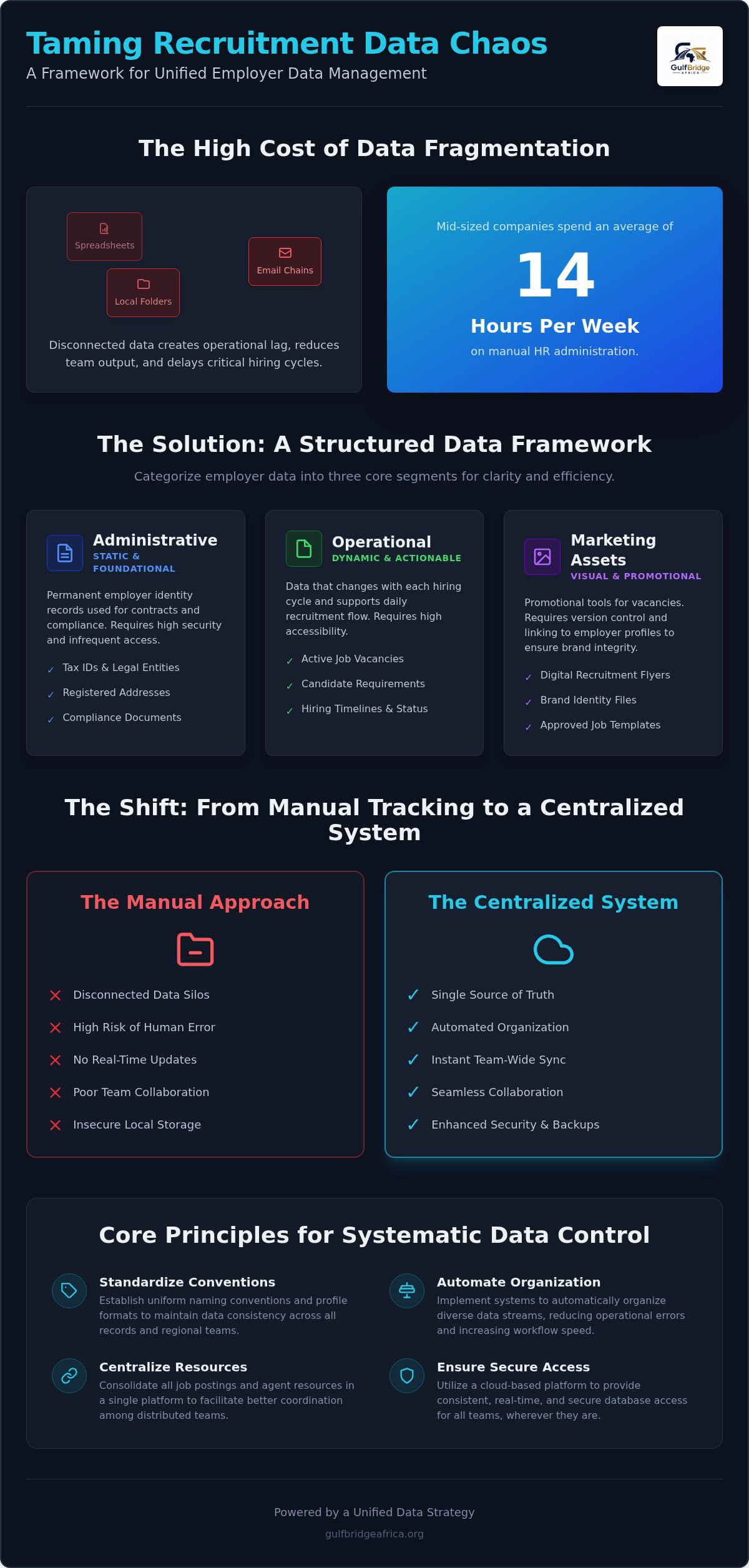
Organizing high volumes of information requires a structured Data governance framework. Without clear divisions, teams struggle to manage multiple employer data types across various workflows. You must group data into three core categories: administrative, operational, and marketing. This systematic approach prevents data overlap and increases the speed of information retrieval. Proper categorization ensures that every team member knows exactly where to store and locate specific records. This structure is essential for maintaining a clean database that supports rapid decision-making across regional operations.
Administrative vs. Operational Data
Administrative records are static. They provide the permanent identity of an employer within your system. These records don't change frequently and include tax IDs, registered legal addresses, and official contact protocols. You use this data primarily for contract generation and compliance tracking. Categorizing these records correctly helps you comply with regulations such as the California Consumer Privacy Act (CCPA) in the US or data sovereignty requirements across African nations. Identifying which files contain sensitive legal information is the first step toward secure data handling.
Operational data is dynamic. It changes with every hiring cycle and reflects the current needs of the employer. This category includes active job vacancies, specific candidate requirements, and hiring timelines. Operational data requires high accessibility for daily updates and team coordination. Separate storage protocols are necessary because administrative data requires higher security and infrequent access, while operational data supports the daily recruitment flow. When you manage multiple employer data types separately, you reduce the risk of cluttering your active workspaces with static legal documents.
Managing Recruitment Marketing Assets
Recruitment marketing assets are visual and promotional tools. Digital flyers are the primary asset in this category. These materials communicate vacancies to candidate pools and must reflect the employer's current brand identity. Managing these as a distinct data type ensures version control. Version control is essential because outdated flyers lead to misinformation regarding job terms or contact details. Use a systematic naming convention to track the most recent approved versions of all promotional materials within your portal.
You must link marketing assets directly to the specific employer profile within your management system. This connection allows recruitment teams to deploy the correct materials immediately when a vacancy opens. This process eliminates the time lost searching through generic folders for brand identity files. A methodical link between employer profiles and marketing assets ensures that agents always use the most recent approved version of a recruitment flyer. This level of organization maintains brand integrity and improves the professional quality of your job postings for both US and African markets.
Centralized Systems for Multi-Type Data Management
Centralization eliminates the inefficiencies of manual data entry and fragmented record-keeping. Using a single cloud environment allows you to manage multiple employer data types without the risks associated with disconnected spreadsheets. Research indicates that mid-sized companies spend an average of 14 hours per week on manual HR administration. Transitioning to a centralized system reduces this time loss. Unified dashboards provide a high-level view of all employer activities. This oversight allows you to identify data gaps immediately. You can see which profiles lack tax documentation or active recruitment assets. Utilizing a professional Employer Data Management Platform ensures all records remain organized and accessible.
The Role of Cloud-Based Accessibility
Cloud-based storage ensures that regional African teams maintain consistent access to a shared database. Agencies operating across different countries require a single source of truth to avoid operational friction. Real-time updates prevent the duplication of effort. When one team member updates a job vacancy, the change reflects across the entire system instantly. This synchronization prevents agents from promoting expired roles to candidates. Centralized cloud storage also provides superior security compared to local storage. It facilitates automated backups and encrypted access. These features protect sensitive employer records from unauthorized breaches and data loss.
Collaborative Workflows and Data Sharing
Collaborative tools facilitate secure data sharing between internal team members and external recruitment agents. You can share specific datasets without compromising the entire employer profile. Setting granular permissions is the standard method for protecting sensitive information. For instance, an administrator grants an agent access to a recruitment flyer but restricts access to the employer's tax ID. This follows a subject-action-result format. The system administrator (subject) restricts (action) sensitive administrative data (result). This systematic approach ensures that every team member has the exact information required for their specific task. It streamlines the workflow and maintains high standards of data privacy across the organization.
Comparing Manual vs. Cloud-Based Data Handling
Manual data entry increases the risk of operational errors. Human oversight often fails when you track diverse datasets across local folders or physical filing cabinets. Searching through localized spreadsheets results in significant time loss and data duplication. A cloud-based system automates the organization of these diverse streams. This automation allows agencies to manage multiple employer data types with high precision. Scalability is a primary benefit of this transition. Automated systems handle increased data volumes without requiring a proportional increase in administrative staff. You can add hundreds of new employer profiles without compromising the system's performance or retrieval speed.
Operational Efficiency Gains
Automation provides measurable efficiency gains in daily recruitment tasks. Research indicates that mid-sized companies with 200 to 1,000 employees spend an average of 14 hours per week on manual HR administration. Transitioning to a cloud-based environment eliminates redundant entry tasks. The system populates related fields automatically once you've entered primary employer information. This process supports faster job vacancy publishing and resource allocation. You don't have to re-enter employer contact details for every new job posting or recruitment flyer. The platform retrieves existing data to complete the task instantly. This subject-action-result logic ensures that administrative efficiency directly improves recruitment speed.
Data Integrity and Accuracy
Centralized systems maintain a single source of truth for all organizational records. Manual systems suffer from data fragmentation. Fragmentation occurs when team members save different versions of the same file on local drives or email attachments. This creates confusion regarding which version is current and accurate. A cloud-based platform prevents this by hosting one master file accessible to all authorized users. Systematic verification protocols ensure that all employer information is accurate before it enters the active workflow. You can implement mandatory fields for tax IDs, legal addresses, and contact protocols. This requirement ensures that no incomplete profiles delay your operations. Accurate data entry leads to reliable reporting and better team coordination. It's essential to manage multiple employer data types through a verified system to maintain professional standards across your regional teams.
Operational Framework for Organizing Employer Records
A formal framework ensures that all team members handle information identically. Disorganized records lead to operational delays and reduced productivity. You must establish a standardized format for every new employer profile created within the system. This practice ensures that no critical data points are omitted during the initial onboarding phase. Consistency allows the system to manage multiple employer data types without creating administrative bottlenecks. Implementing a systematic naming convention for all data files further simplifies the retrieval process. Every document should follow a predictable structure, such as [EmployerID]_[DataType]_[Date], to facilitate rapid identification during high-pressure recruitment cycles.
Standardizing Data Entry
Mandatory fields provide the foundation for long-term data integrity. Every employer record must include the legal entity name, tax identification number, and primary contact protocol. You should also utilize standardized templates for job postings and recruitment flyers. These templates ensure that all outputs maintain a professional appearance and contain all necessary information for candidates. When adding notes to a record, follow a subject-action-result format. For example, "Recruiter (subject) updated (action) the hiring timeline (result)." This clarity prevents ambiguity in team communications and ensures that every update is actionable for the next person in the workflow.
Data Auditing Protocols
Regular audits maintain the accuracy of your database and prevent information decay. Schedule a monthly data integrity check to verify that all active records are current and complete. This process involves identifying and resolving conflicting data entries where multiple versions of information might exist. You must also update employer contact protocols to reflect any changes in personnel or communication preferences. Developing a protocol for archiving inactive employer data is equally important for system performance. Archiving moves old records into a secondary storage area. This keeps the active environment streamlined and ensures that your team only interacts with relevant, current information.
Using a dedicated Employer Data Management Platform provides the tools necessary to enforce these standards across your entire organization. This platform acts as a silent partner in your workflow, providing the structure required for systematic record-keeping. All team members must adhere to these entry standards to prevent the accumulation of low-quality data. Consistent oversight ensures that your recruitment operations remain fast, reliable, and scalable as your agency grows.
Implementing Systematic Data Control with GulfBridge Africa
GulfBridge Africa provides a utilitarian platform designed to manage multiple employer data types within a single cloud environment. The platform functions as a silent, reliable partner in your daily recruitment operations. It prioritizes clarity and operational efficiency over complex flourishes. You centralize employer information, job postings, and agent resources to eliminate the friction caused by disconnected tools. Accessing the platform online supports regional African operations by providing a consistent interface for distributed teams. Every team member interacts with the same data structures. This consistency ensures that work progresses without the delays associated with manual information syncing. The system provides the necessary framework for systematic organization without demanding the spotlight.
Utilizing the Employer Data Management Platform
The Employer Data Management Platform allows you to organize and track all employer information in one place. You establish a master record for every employer. This record contains the administrative data needed for compliance and the operational data required for hiring. A centralized employer database ensures that every department accesses the same source of truth. Sharing work with team members follows a direct subject-action-result format. You select a specific record (subject). You grant access permissions (action). The team member receives the data (result). This process maintains data security while facilitating collaboration. It eliminates the need for email attachments or physical file transfers. You maintain total oversight of who accesses specific data types at all times.
Managing Job Postings and Agent Resources
The Job Posting Service streamlines the process of publishing vacancies on the portal. You enter the vacancy details directly into the system. The platform links this information to the existing employer profile. This action ensures that all job postings contain accurate administrative details. The Agent Resource Portal functions as a centralized hub for data sharing with recruitment partners. Agents log in to the portal to retrieve the latest approved resources. You integrate recruitment flyers into the workflow by attaching them to specific job postings. This integration ensures that agents always use the correct marketing assets for every vacancy. The recruiter (subject) uploads (action) the digital flyer (result). Version control occurs automatically as you update the files in the central repository. Agents download the current flyer. They deploy it to candidate pools. This systematic approach reduces the risk of miscommunication and improves recruitment outcomes.
Establishing Long-Term Operational Efficiency
Systematic organization is the foundation of a scalable recruitment agency. You must categorize records into administrative and operational streams to ensure data integrity. Transitioning from manual spreadsheets to a cloud-based environment reduces administrative time loss and minimizes entry errors. A standardized framework for naming files and auditing records ensures that your database remains a reliable source of truth for all team members. These steps eliminate the friction caused by data fragmentation and localized storage.
When you manage multiple employer data types through a unified system, your team's workflow becomes predictable and efficient. You can focus on executing recruitment tasks rather than searching for fragmented information. GulfBridge Africa provides a cloud-based data management platform with regional support for African agencies. The system includes integrated job posting and resource tools designed for immediate utility. It functions as a silent, reliable partner in your daily operations.
Streamline your data management with GulfBridge Africa today. Establishing these systematic controls now will support your agency's growth and maintain professional standards across all regions.
Frequently Asked Questions
What are the most common employer data types to manage?
The most common categories include administrative, operational, and marketing data. Administrative data consists of static information like tax IDs and legal addresses. Operational data is dynamic and includes active job vacancies and hiring timelines. Marketing assets involve digital recruitment flyers and brand identity materials. Categorizing these types separately prevents data overlap and improves the speed of information retrieval across your organization.
How can I securely share employer data with my recruitment agents?
Secure data sharing is achieved through an Agent Resource Portal with granular permission settings. You assign specific access levels to different team members or external agents. This follows a subject-action-result format where the administrator restricts sensitive administrative data while providing access to operational assets. This method ensures that agents have the exact resources they need without compromising the security of the entire employer profile.
Why should African agencies move from spreadsheets to cloud-based systems?
Moving to cloud systems eliminates the inefficiencies of manual data handling. Research indicates that mid-sized companies spend an average of 14 hours per week on manual HR administration. Cloud-based storage provides regional African teams with real-time access to a shared database. This transition reduces the risk of operational errors and ensures that all team members work from a single source of truth rather than fragmented spreadsheets.
Is it possible to track job vacancy progress and employer data in one system?
You can track job vacancy progress and employer data within a unified Employer Data Management Platform. This integration allows you to manage multiple employer data types without the need for multiple manual spreadsheets. Linking active recruitment cycles directly to the employer's master profile ensures that job postings are always accurate. This oversight allows you to identify data gaps and monitor recruitment workflows through a single administrative interface.
How do I organize recruitment marketing assets like digital flyers?
Organize marketing assets by linking approved digital flyers to specific employer profiles within your centralized system. Use a systematic naming convention to track different versions of promotional materials. This practice ensures that agents only access the most recent approved flyers for their recruitment tasks. Storing these assets in an Agent Resource Portal facilitates immediate deployment and maintains brand consistency across all job postings.
What is the best way to handle data from multiple employers simultaneously?
The best method is to implement a standardized operational framework that allows you to manage multiple employer data types through a unified dashboard. Establish mandatory entry fields and consistent naming conventions for all new profiles. This structure ensures that your database remains organized as you scale. Utilizing automated categorization reduces the time spent searching for specific employer records and improves the overall efficiency of your recruitment agency.
Can I manage regional agent data alongside employer records?
You can manage regional agent resources alongside employer records in a single cloud environment. Centralizing these data streams facilitates better coordination between distributed teams operating across different regions. The Agent Resource Portal allows you to track how agents utilize recruitment flyers and job posting tools. This integrated approach provides a high-level view of all activities and ensures that your administrative oversight remains consistent across the entire organization.


