

The Middle East and Africa HR software market reached a value of USD 1,823.7 million in 2025. This growth signals a transition toward systematic data management and the adoption of recruitment automation software Africa. Many agencies still rely on manual spreadsheets to track candidates. This method often results in data loss and slow communication with international employers. It makes tracking agent performance across different regions difficult and inefficient.
You likely recognize that fragmented workflows hinder your agency's ability to scale. Manual processes create bottlenecks that increase time-to-hire and reduce operational clarity. A centralized platform replaces disorganized files with a reliable, digital framework. This structure ensures that employer and candidate data remain accessible and organized in one location. It provides the oversight necessary for managing regional teams and global client requirements.
This guide outlines the systematic process for identifying internal bottlenecks and implementing automation tools. You'll learn how to transition from manual entries to a repeatable, digital workflow. We focus on practical steps to ensure data integrity and improve coordination between regional agents and international employers. The following sections provide a checklist for optimizing your recruitment operations.
Key Takeaways
- Identify specific bottlenecks in manual data entry and regional communication to prioritize operational improvements.
- Map every recruitment stage to establish standard data requirements and ensure consistent tracking of candidate progress.
- Select recruitment automation software Africa that prioritizes cloud-based collaboration and secure employer data management.
- Execute a structured five-step transition plan to migrate existing data and validate new workflows through pilot testing.
- Leverage centralized databases and agent portals to scale operations and manage multiple international recruitment contracts efficiently.
Identifying Operational Bottlenecks in African Recruitment
Identifying operational bottlenecks is the first step toward systematic efficiency. Many African recruitment agencies rely on decentralized spreadsheets or paper files to manage candidate data. This approach creates significant delays in the recruitment process and increases the risk of information loss. Implementing recruitment automation software Africa centralizes these fragmented data points into a single, accessible environment. It allows managers to track progress without requesting manual status updates from individual staff members.
The Cost of Manual Candidate Tracking
Manual candidate tracking consumes intensive administrative labor. Administrative staff often allocate hours daily to manual CV screening, filing, and data entry. These repetitive tasks divert resources from high-value activities like interviewing and client management. Searching for specific skills within paper archives or local drives is time-consuming and often unsuccessful. This lack of searchability prevents agencies from leveraging their existing candidate pools for new job orders. Manual systems don't scale effectively; as the volume of job requisitions increases, the administrative burden grows linearly. This leads to missed deadlines and a decrease in service quality.
Fragmented Employer and Agent Communication
Communication gaps between local agents and international employers frequently cause placement delays. Using recruitment automation software Africa helps bridge the gap between regional agents and global clients. Reliance on email-only communication with Gulf-based employers leads to fragmented information and slow feedback loops. Agencies often struggle to track interactions across multiple email threads, which makes it difficult to verify employer requirements or previous agreements.
Visibility into sub-agent activities is also limited in manual systems. Without a shared agent resource portal, tracking the performance of regional partners is nearly impossible. This fragmentation results in slow response times, which negatively impacts candidate placement rates. High-quality candidates often accept other offers when agencies can't confirm interview dates or job details quickly. Centralizing these interactions ensures that all team members access the same information, which reduces the following bottlenecks:
- Redundant data entry into multiple regional spreadsheets.
- Difficulty retrieving candidate history from physical or local files.
- Delayed feedback from international employers due to email silos.
- Lack of performance tracking for regional sub-agents.
Decentralized systems also create a high risk of data loss. Storing candidate information on individual computers means that a hardware failure or staff turnover can result in the permanent loss of valuable records. A centralized system provides a stable framework for data handling. It ensures that employer and candidate information remains secure and accessible to authorized team members at all times. This systematic organization reduces the time between a job requisition and the final placement.
Mapping Your Recruitment Workflow for Automation
Systematic automation requires a detailed map of current operations. You must document every stage from the initial job requisition to the final candidate placement. This documentation identifies the specific points where data enters the system and where it must be validated. Understanding these transitions is essential before implementing recruitment automation software Africa. It ensures that the digital environment mirrors your operational needs rather than complicating existing tasks.
Defining the Candidate Journey
The candidate journey consists of specific milestones that require consistent documentation. You should list every step, including initial sourcing, preliminary screening, medical clearance, and final onboarding. Each phase requires a standard set of data points. For example, the screening phase might require a digital copy of the passport, educational certificates, and professional references. Establishing a checklist for these documents prevents delays during the final placement phase. Standardizing evaluation criteria across different job roles ensures that all candidates are assessed against the same benchmarks. This consistency is vital when using recruitment automation software Africa to manage high volumes of applications.
Standardizing Employer Data Collection
Centralizing employer data is a core component of workflow optimization. You must define the necessary fields for your database to ensure that all team members capture the same information. Essential fields include:
- Company registration and international license details
- Specific job descriptions and skill requirements
- Salary structures and benefit packages
- Historical placement data and communication logs
Establishing protocols for sharing these requirements with regional agents reduces communication errors. When agents access standardized employer data, they can source candidates more accurately. Real-time tracking of job vacancy progress allows managers to adjust sourcing strategies based on current fulfillment rates. This level of organization has significant implications for African development by improving labor market efficiency and transparency.
Assigning clear ownership for data entry is critical for maintaining database integrity. One staff member should be responsible for entering new job orders, while another validates candidate documentation. Identifying repetitive tasks, such as sending status updates or generating recruitment flyers, allows you to target these areas for software-driven solutions. Using an Employer Data Management Platform provides the necessary structure for this organized approach. This methodical mapping prepares your agency for a successful transition to digital tools.
Selecting Recruitment Automation Software for the African Market
Selecting recruitment automation software Africa requires a focus on operational utility rather than marketing claims. You must prioritize cloud-based access to facilitate collaboration between regional offices and international partners. A centralized system ensures that all team members work from a single version of truth. Security features are essential to protect sensitive employer information and candidate records. You should verify that the platform includes robust encryption and access controls to maintain data integrity across your network.
Mobile accessibility is a critical requirement for agents working in the field. Field agents often source candidates in areas with limited desktop access. A mobile-responsive interface allows them to upload documents and update candidate statuses immediately. You should also check for integrated tools like recruitment flyer generators. These tools allow your team to create standardized marketing materials quickly. This functionality supports Africa's technology and AI opportunity by digitizing traditional recruitment methods.
Essential Features for Regional Agencies
Regional agencies require specific features to manage complex supply chains. You should assess the importance of an integrated Agent Resource Portal. This portal allows you to coordinate with sub-agents and track their sourcing progress in real-time. The software must allow the management of multiple data types, including employer contracts, job descriptions, and candidate certifications. Prioritize platforms that support collaborative recruitment workflows when evaluating recruitment automation software Africa. This ensures that tasks move seamlessly from sourcing agents to screening managers without manual handovers.
Infrastructure and Accessibility Considerations
Infrastructure varies significantly across the continent. You must evaluate software performance in low-bandwidth regions to ensure consistent uptime. The platform should support offline-to-online data synchronization. This feature allows agents to enter data without a stable internet connection and sync it once they reach a network. Verify the ease of use for all team members. The interface should be intuitive enough for users with varying technical skills to navigate without extensive training. Methodical software selection reduces implementation friction and supports long-term operational scaling.
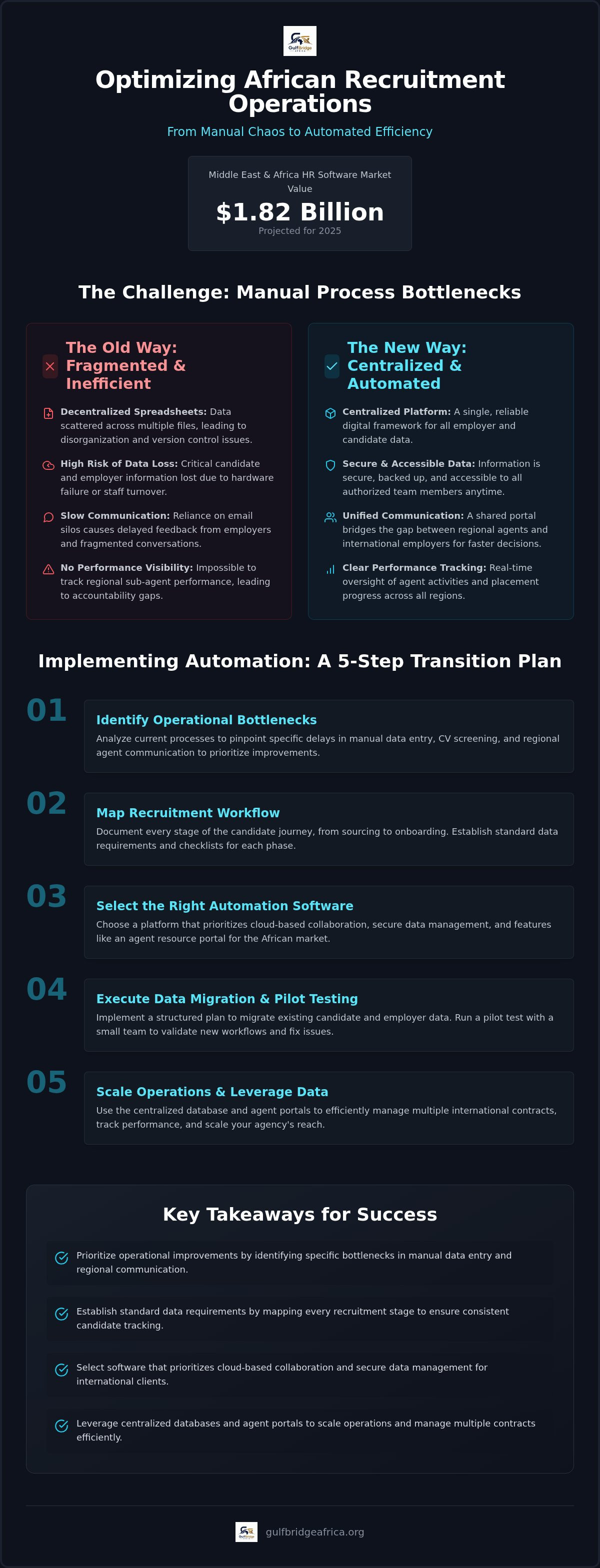
Implementing Automation: A 5-Step Transition Plan
Transitioning to recruitment automation software Africa requires a methodical approach to prevent operational downtime. A structured five-step plan ensures that your agency migrates data accurately and adopts new tools without disrupting ongoing placements. This process begins with data preparation and concludes with performance monitoring to validate efficiency gains. Accuracy is mandatory. Disorganized implementation often leads to data silos and team resistance.
Data Cleaning and Migration Strategies
Existing recruitment data often contains errors that impede software performance. You must identify and remove duplicate candidate and employer records before initiating a migration. Mapping existing spreadsheet columns to the specific fields in your new software ensures that information remains searchable and organized. This step is critical for compliance with regional regulations. For example, the Nigeria Data Protection Commission can issue fines of up to 2% of annual turnover for non-compliance with data handling rules. In Kenya, the Data Protection Act allows for fines up to 5 million KES. Cleaning your data ensures you meet these legal standards while maintaining a functional database. Schedule the data migration during low-activity periods to minimize the impact on active recruitment campaigns. Systematic preparation prevents the transfer of disorganized information into your new digital environment.
Team Training and Adoption
Software utility depends entirely on consistent team usage. Conduct functional training sessions for all recruiters and regional agents to ensure they understand the new systematic entry requirements. You should create simple internal guides that outline common tasks, such as uploading documents or updating candidate statuses. Establishing a feedback loop allows you to address technical challenges or navigation errors early in the transition. This open communication ensures that the platform remains a helpful tool rather than an administrative burden. Team members must see the immediate utility of the system to maintain high adoption rates.
Start small. Run a pilot program with a single recruitment campaign before moving your entire operation. This limited scope allows you to test the workflow and identify any remaining bottlenecks. You can then integrate a Job Posting Service into daily tasks to automate the distribution of vacancies across multiple channels. Monitor operational metrics to measure efficiency gains. Track the time taken for initial screening and the rate of data completion. Use these insights to refine your processes. Consistent reporting provides the oversight needed to ensure that the transition delivers a reduced time-to-hire. This methodical implementation creates a stable foundation for long-term growth.
Scaling Operations with Centralized Recruitment Databases
Scaling recruitment operations requires a shift from manual tracking to a data-centric model. Centralized databases allow agencies to manage multiple international contracts. This management occurs without increasing administrative staff proportionally. Using recruitment automation software Africa ensures that candidate and employer records remain organized as the volume of job orders grows. This systematic approach provides the necessary framework for long-term growth and operational stability. It replaces the chaos of individual files with a unified digital archive.
Managing Global Employer Relationships
International recruitment contracts require precise data handling and consistent updates. Implementing a structured employer data management system centralizes all client requirements and communication logs. This centralization allows managers to track recruitment progress for international clients in real-time. Cloud tools provide manpower agencies with the ability to share data across borders instantly. This visibility reduces the time spent on status reports. It allows for quicker decision-making during the selection phase. Gulf-based employers receive candidate profiles that match their specific regulatory and skill requirements without delay.
Optimizing Agent Networks
Expanding your sourcing reach across Africa depends on a well-coordinated agent network. You can monitor sub-agent productivity through centralized tracking within the platform. This oversight identifies which regional partners deliver the highest quality candidates for specific roles. You can also distribute standardized recruitment flyer designs through the platform to ensure consistent branding. This distribution maintains your agency's professional image across all regional offices. Centralized distribution prevents agents from using outdated or incorrect job information during their sourcing activities.
Reporting tools within recruitment automation software Africa identify high-performing recruitment channels. You can analyze which sourcing methods yield the highest placement rates. This analysis allows you to adjust your recruitment budget accurately. Maintaining a searchable database of previously screened candidates creates a pipeline for future job vacancy listings. This reduces the need for fresh sourcing for every new contract. A searchable archive allows you to filter candidates by skill, location, or previous experience in seconds. This speed is a competitive advantage when responding to urgent manpower requests. A methodical database strategy transforms your agency from a reactive operation into a proactive, scalable business. It provides a foundation for consistent performance across diverse African markets.
Optimizing Recruitment Operations for Scalable Growth
Transitioning from manual spreadsheets to a digital framework is essential for managing international placements. You've learned how to identify operational bottlenecks and map your workflows for maximum efficiency. Implementing recruitment automation software Africa provides the structure needed to manage complex data across regional borders. This systematic approach reduces time-to-hire and ensures that candidate information remains secure and searchable at all times.
A centralized system replaces fragmented communication with clear, trackable interactions. You can now coordinate with regional agents and international employers through a single version of truth. This organization allows your agency to scale without increasing administrative complexity. You're prepared to handle larger contracts while maintaining high data integrity standards across your entire network.
Start organizing your recruitment data with GulfBridge Africa. Our cloud-based platform provides the tools for organizing and tracking your work in one place. You gain access to digital recruitment flyer tools and a centralized agent resource portal for regional coordination. Establishing an efficient workflow ensures your agency remains a reliable partner in the global labor market.
Frequently Asked Questions
What is the first step to streamline recruitment workflows?
The first step is identifying operational bottlenecks within your current recruitment process. You must analyze the time your staff allocates to manual data entry and CV screening. Identifying these gaps allows you to prioritize which tasks require immediate automation. This systematic evaluation ensures that you address the most significant delays first. Documenting these inefficiencies provides a clear baseline for measuring future performance gains after implementing new software tools.
How does recruitment automation software improve candidate quality?
Recruitment automation software Africa improves candidate quality by enforcing standardized evaluation criteria across all job roles. Digital screening tools ensure that only candidates meeting specific skill and documentation requirements proceed to the interview stage. This consistency reduces the risk of human error during the selection process. Faster processing times also allow agencies to secure high-quality candidates before they accept competing offers. Centralized tracking ensures that previous performance data informs future hiring decisions.
Can small recruitment agencies in Africa afford automation software?
Small recruitment agencies can access automation tools through scalable SaaS subscription models. These platforms allow agencies to pay for the specific features and user seats they require. This approach eliminates the need for significant upfront investment in hardware or custom software development. By automating repetitive administrative tasks, small agencies can handle a higher volume of job orders without increasing their headcount. Digital tools provide the necessary infrastructure for smaller teams to compete with larger regional firms.
Is a cloud-based recruitment database secure for employer data?
Cloud-based databases provide robust security features for protecting sensitive employer and candidate information. These platforms utilize encryption and multi-factor authentication to prevent unauthorized access to your data. Centralized storage is more secure than decentralized spreadsheets, which are vulnerable to hardware failure or local data breaches. Most providers also ensure compliance with regional regulations like the Nigeria Data Protection Act. Regular automated backups ensure that your operational records remain accessible even during local technical disruptions.
How do I manage recruitment agents across different African countries?
You manage regional agents effectively by utilizing a centralized Agent Resource Portal. This tool allows you to track sub-agent productivity and sourcing progress in real-time across multiple countries. You can distribute standardized recruitment flyers and job descriptions to ensure consistent branding and information. Centralized tracking identifies high-performing agents and highlights regions that require additional support. This oversight ensures that all partners follow the same data collection protocols, which improves the overall placement rate.
What are the benefits of using a centralized employer database?
A centralized employer database provides a single version of truth for all client interactions and requirements. Team members can access historical placement data, communication logs, and contract details from any location. This organization reduces the time spent on internal status updates and manual reporting. It allows manpower agencies to track recruitment progress for international clients with higher precision. Centralizing this data ensures that employer requirements remain visible to all authorized staff, which minimizes communication errors.
Do I need a specialized recruitment tracking system for Gulf jobs?
Recruitment for Gulf jobs requires a system capable of managing specific documentation, such as medical clearances and visa status. Using recruitment automation software Africa that supports multiple data types ensures you track these critical milestones accurately. A specialized approach allows you to coordinate between African sourcing agents and Gulf-based employers within a unified environment. This structure is essential for meeting the strict regulatory requirements of international labor markets. Automated tracking ensures that no candidate proceeds without the necessary legal certifications.
How long does it take to implement recruitment software?
Implementation typically takes several weeks, depending on the volume of data you need to migrate. A phased approach allows you to clean existing records and train staff without stopping your current operations. You should start with a pilot program for a single recruitment campaign to validate the new workflow. Full adoption occurs once you integrate job posting services and agent portals into daily tasks. Consistent monitoring during the first month ensures that any technical or navigation challenges are addressed early.


