

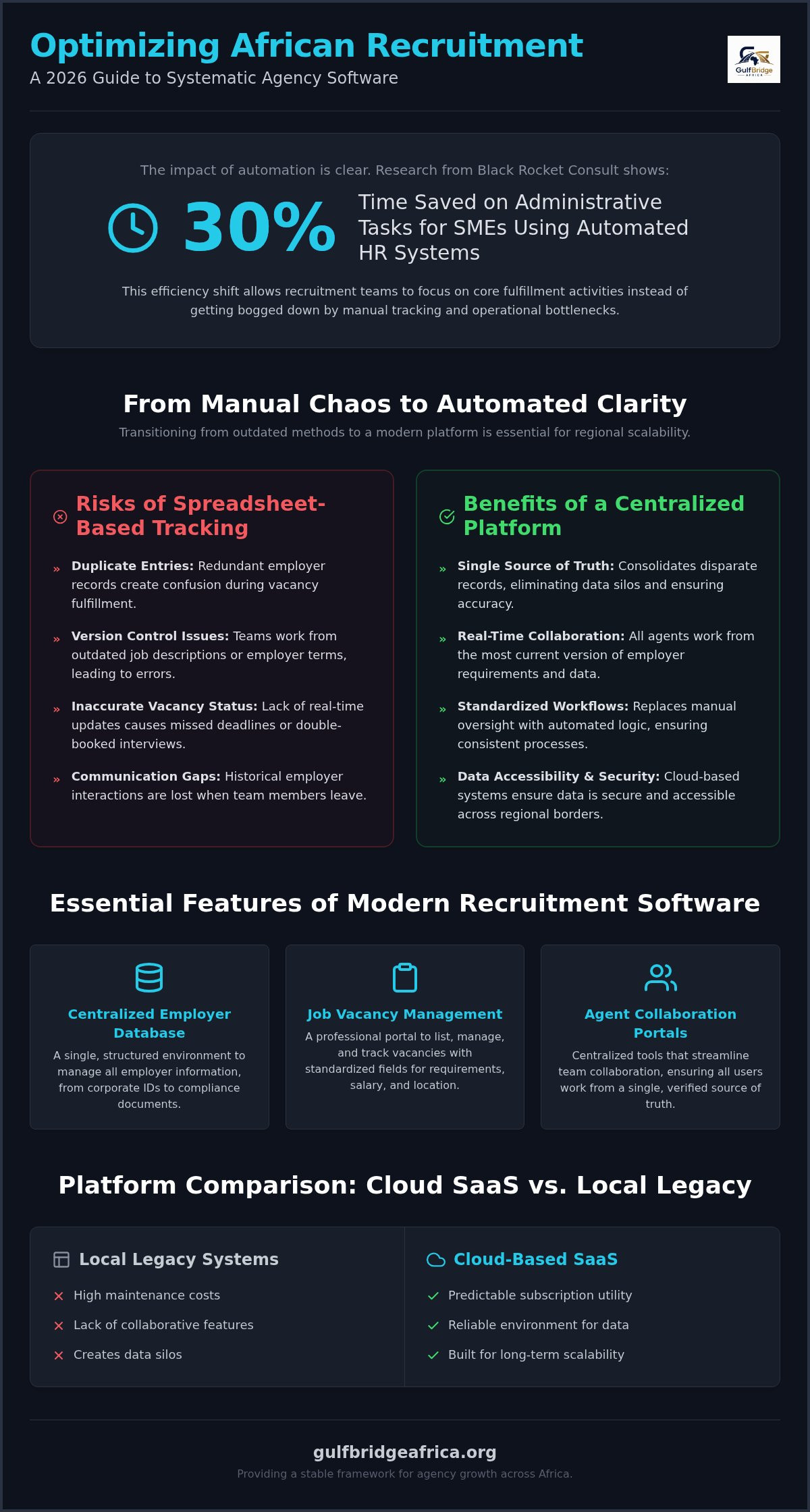
Research from Black Rocket Consult indicates that SMEs using automated HR systems saved 30% of their time on administrative tasks by 2025. Reliable recruitment agency software Africa provides the structure needed to manage complex regional data. Fragmented employer records and disconnected team workflows often reduce operational speed. Agencies require a methodical approach to maintain professional standards across diverse markets.
You likely find that manual tracking systems create bottlenecks in your daily operations. This 2026 buying guide identifies the specific data management capabilities and operational features required for a systematic recruitment platform. We will outline the requirements for a centralized employer database and streamlined job vacancy management. This overview covers the utility of digital recruitment assets and agent collaboration portals for regional teams.
Key Takeaways
- Transition from manual record-keeping to cloud-based systems to ensure data accessibility across regional borders. This shift improves operational efficiency for recruitment teams.
- Identify the core modules required to select a functional recruitment agency software Africa that supports systematic workflows. A professional job posting portal is essential for modern employer engagement.
- Compare the maintenance costs of local legacy software against the predictable utility of SaaS subscriptions. Cloud storage provides a more reliable environment for long-term data management.
- Implement a structured framework to categorize and organize employer information. This systematic approach allows for the rapid retrieval of critical recruitment data during high-volume periods.
- Utilize professional digital recruitment assets and agent portals to streamline team collaboration. Centralized tools ensure all users work from a single, verified source of truth.
Understanding the Operational Requirements for Recruitment in Africa
Recruitment agency software Africa functions as a structured data management environment rather than a simple contact list. It acts as the operational core for manpower agencies managing cross-border placements. In 2026, the transition from manual record-keeping to cloud-based systems is a standard requirement for regional scalability. Agencies must manage large volumes of regional employer information through a centralized database to maintain oversight. Systematic organization ensures that data remains accessible, accurate, and secure across multiple jurisdictions. This approach minimizes the time spent on administrative tasks and allows teams to focus on core fulfillment activities.
The Role of Data Management in Regional Hiring
Implementing employer data management systems reduces operational friction by consolidating disparate records into a single interface. Agencies often handle multiple employer data types, including corporate tax IDs, job specifications, and compliance documentation. Storing these variables in one place improves team productivity by removing data silos. Users can retrieve necessary documents instantly without searching through physical files or local desktop folders. This immediate data accessibility allows regional teams to collaborate effectively on high-volume recruitment projects. It ensures that every recruiter uses the most current version of an employer's requirements.
Challenges of Traditional Manpower Management
Traditional methods often rely on basic spreadsheets or local document storage that lack collaborative features. While many agencies use an Applicant Tracking System (ATS) to manage candidate flow, they often neglect the employer side of the data equation. Spreadsheet-based tracking leads to several operational risks that compromise agency reliability. Data entry errors frequently occur when multiple users access the same file. Fragmented data creates significant hurdles when working with international agents who require clear, professional job assets to begin their work.
Common errors in spreadsheet-based recruitment tracking include:
- Duplicate entries: Redundant records cause confusion during the vacancy fulfillment process.
- Version control issues: Team members often work from outdated job descriptions or employer terms.
- Inaccurate vacancy status: Lack of real-time updates leads to missed deadlines or double-booked interviews.
- Communication gaps: Historical records of employer interactions are often lost when staff members leave.
Transitioning to a cloud-based workforce management system provides a stable framework for agency growth. It replaces manual oversight with automated logic and standardized workflows. This shift ensures that every agent and team member follows the same systematic process. Centralized tools provide the oversight necessary to manage complex recruitment agency software Africa requirements while maintaining professional standards.
Essential Features of Modern Recruitment Agency Software
Modern recruitment agency software Africa requires specific functional modules to support high-volume operations. These include employer data management, job posting interfaces, and agent collaboration portals. Systematic campaign management relies on the availability of professional digital assets. These tools contribute to bridging Africa's digital divide by standardizing administrative processes across regional borders. A functional platform eliminates the need for disconnected tools and manual data entry. It provides a stable environment for managing complex workforce requirements.
Centralized Employer and Job Vacancy Portals
A professional job posting portal allows agencies to list and manage vacancies through a single interface. Users input specific job requirements, salary ranges, and location data into standardized fields. This structured approach maintains employer branding by ensuring consistent messaging across all digital channels. A centralized database improves the utility of manpower agency management software in Africa by linking vacancies directly to verified employer profiles. This connection ensures that all recruitment activities remain aligned with the original client request. Agencies track the status of each vacancy from initial posting to final placement within the same environment.
Collaborative Tools for Recruitment Agents
Agent resource management modules provide a secure environment for sharing data with external partners. Agencies upload recruitment flyers and job specifications to a portal for agents to download. This process eliminates the need for fragmented email chains or insecure file-sharing methods. Secure access controls ensure that agents only view information relevant to their assigned tasks. Tracking tools allow managers to monitor recruitment progress across multiple regional teams in real time. This oversight is necessary for maintaining professional standards when working with third-party contributors. It results in a transparent workflow where every participant understands their specific responsibilities.
Digital recruitment assets such as standardized flyers and job summaries facilitate faster campaign launches. These assets provide agents with the professional tools they need to represent the agency effectively. Consistent data handling across these modules reduces the risk of operational errors. Agencies looking to organize these workflows can utilize a professional employer data management platform to centralize their records. This systematic approach ensures that every team member has access to the same verified information. It creates a reliable framework for daily task management and long-term organizational growth.
Comparing Cloud-Based Platforms vs. Local Legacy Systems
Recruitment agency software Africa utilizes different infrastructure models to store and process data. Local legacy systems rely on on-site servers that require physical maintenance and manual updates. Cloud-based platforms host information on remote servers, providing instant synchronization across all user accounts. This infrastructure difference determines how efficiently an agency manages its regional operations. Cloud storage removes the risk of data loss due to hardware failure. It ensures that recruitment records remain available even if local office equipment is compromised. This model supports a systematic approach to data handling that local systems cannot replicate without significant investment.
Accessibility and Regional Connectivity
Online access is vital for recruitment agents operating in different cities or regional hubs. Cloud systems allow users to log in from any location with an internet connection. This supports both mobile and desktop workflows, allowing staff to manage tasks from the field or the office. Data consistency is maintained because every update reflects instantly across the entire network. Regional offices don't need to send manual reports or export files to a central branch. Instead, the platform functions as a single, live environment for all recruitment activities. This connectivity reduces the operational delays associated with traditional manpower management methods. It allows teams to coordinate their efforts without geographical constraints.
Cost Efficiency and Scalability
SaaS subscription models provide predictability for agency budgeting. Agencies pay a fixed monthly fee based on their required utility or user count. This replaces the high initial investment required for legacy hardware and software licenses. Cloud platforms scale automatically as an agency grows. They allow for the addition of new users or increased data storage without infrastructure changes. Legacy systems often require expensive hardware upgrades to handle expanded data volumes. Maintenance costs for local systems include server repairs, electricity for cooling, and dedicated IT support. SaaS models consolidate these expenses into a single operational cost. This allows agencies to allocate financial resources toward recruitment activities rather than IT infrastructure management.
Security in cloud-based recruitment databases relies on professional encryption and redundant backups. These systems protect employer data from unauthorized access through multi-factor authentication and role-based permissions. Professional providers manage security patches and system updates automatically. This removes the administrative burden of manual security management from the agency staff. It creates a stable environment where data integrity is prioritized through systematic oversight. Agencies maintain control over their information while benefiting from enterprise-grade security protocols.
Implementing Systematic Data Management for Recruitment Teams
Operational speed in workforce placement depends on the quality of internal data structures. Agencies must move beyond simple storage to implement a methodical framework for information handling. Recruitment agency software Africa provides the necessary environment to execute these workflows. A systematic approach ensures that every team member accesses verified information without delay. This reduces the risk of administrative errors and improves the reliability of regional operations. Organizations follow a 5-step framework to transition from fragmented files to a structured database.
The 5-step framework for organizing employer information includes:
- Data Acquisition: Collect all verified employer credentials and job specifications.
- Standardization: Map information to uniform fields within the software interface.
- Classification: Categorize records by industry sector and geographic region for rapid retrieval.
- Centralization: Upload all digital recruitment assets to a shared cloud environment.
- Maintenance: Audit records on a weekly schedule to ensure data integrity and accuracy.
Organizing Employer Records Efficiently
Admin users enter data using a subject-action-result format to maintain clarity. A staff member [subject] updates a vacancy status [action] to notify the recruitment team [result]. This repetitive structure reinforces the core purpose of each entry. Consistent record management prevents the loss of historical data when personnel changes occur. Agencies use a standardized checklist to ensure every employer profile is complete.
Essential employer data points include:
- Company legal name and tax identification.
- Primary and secondary contact information.
- Specific job requirements and salary ranges.
- Verified compliance and licensing documentation.
- Detailed terms of business and historical placement data.
Streamlining Team Collaborative Workflows
Assigning tasks within a single platform prevents the double-handling of employer requests. Managers distribute vacancies to specific recruiters through the software interface. This centralized oversight reduces redundancy by ensuring that two agents don't contact the same employer for the same role. Recruitment agency software Africa allows for the secure sharing of job specifications with external agents. These partners access the agent resource portal to download approved recruitment flyers. This methodology ensures that all promotional activities remain professional and accurate.
Tracking recruitment progress requires monitoring specific operational metrics. These include time-to-fill for active vacancies and the accuracy rate of data entries. Real-time dashboards provide visibility into the performance of different regional offices. Agencies can implement these structures by using a professional Employer Data Management Platform to maintain organized records. This systematic oversight results in a more efficient and transparent recruitment process for all stakeholders.
Optimizing Agency Workflows with GulfBridge Africa
GulfBridge Africa provides a functional environment for managing workforce data. The platform functions as a reliable partner in the user's workflow by centralizing administrative tasks. Agencies use the recruitment agency software Africa to maintain structured records across regional teams. This systematic approach improves operational efficiency by removing the friction associated with fragmented data. The environment prioritizes clarity and task management over emotional resonance. Every feature supports the practical reality of regional recruitment oversight.
The Employer Data Management Platform allows for systematic record-keeping of corporate clients. Users input multiple data types into a single, searchable interface to ensure data consistency. This centralized database ensures that all team members access the same verified information at all times. The Job Posting Service allows African employers to list vacancies within a professional framework. This service connects specific job requirements directly to the agency's internal management tools. It ensures that every vacancy remains visible to authorized users and agents for immediate action.
The Agent Resource Portal supports collaborative workflows between agencies and their regional partners. Agencies share critical recruitment information through a secure, centralized environment to reduce communication delays. This portal provides agents with immediate access to the tools required for vacancy fulfillment. It functions as a structured guide for third-party contributors, ensuring they follow agency standards. This collaborative utility is a core component of recruitment agency software Africa in 2026.
Professional Recruitment Marketing Assets
The digital recruitment flyer tool generates standardized assets for active campaigns. Users create professional flyers to provide agents with clear job specifications in a visual format. These flyers ensure consistent branding and accurate information across all recruitment channels. Recruiters manage these marketing assets within the platform to maintain version control and prevent the use of outdated materials. Professional flyers increase the utility of agent resources by providing ready-to-use promotional materials for immediate distribution. This process standardizes the representation of the agency across different regional markets.
Operational Oversight and Progress Tracking
The platform enables users to organize, track, and share work through a unified dashboard. Managers monitor the status of vacancies and agent contributions in real time to maintain project timelines. This oversight ensures that every task moves toward completion without redundancy. The GulfBridge environment maintains a neutral, professional reliability that supports high-volume operations. It projects an image of stability and systematic logic for users who value organization. Users streamline their hiring processes by utilizing the GulfBridge Africa portal for daily data management and team coordination.
Modernizing Regional Recruitment Operations
Modernizing your recruitment workflow requires a shift from fragmented local storage to a centralized cloud environment. This transition ensures that every team member accesses the same verified employer data and job specifications. Implementing a systematic framework for data organization reduces administrative errors and improves regional oversight. Reliable recruitment agency software Africa provides the necessary infrastructure to manage these complex workflows across different borders. It acts as a silent partner in your daily operations.
Agencies that prioritize operational efficiency benefit from standardized processes and real-time progress tracking. You can maintain professional standards by utilizing dedicated tools for agent collaboration and vacancy management. This approach creates a stable foundation for organizational growth and regional scalability. It removes the uncertainty of manual record-keeping by providing a single source of truth for all users. Methodical oversight is the key to consistent performance.
You are invited to Access the GulfBridge Africa Platform to manage your workforce data. The system features cloud-based data management for regional teams and an integrated job vacancy listing service. Users also gain access to a professional agent resource portal to streamline collaboration. This structured environment supports your daily tasks with methodical precision. It's a reliable framework for your professional environment.
Frequently Asked Questions
What is recruitment agency software and how does it benefit African agencies?
Recruitment agency software Africa is a systematic environment designed to manage employer data and job vacancies. It benefits agencies by consolidating fragmented records into a single, searchable database. This centralization allows regional teams to access verified information without administrative delays. Agencies use these platforms to maintain professional standards across different borders. It provides the structure required to scale operations while maintaining data integrity across the regional workforce.
How does a cloud-based recruitment database improve data security?
Cloud-based databases improve security through professional encryption and automated redundant backups. These systems protect sensitive employer information from unauthorized access using multi-factor authentication. Role-based permissions ensure that staff members only access data relevant to their specific tasks. Storing data on remote servers removes the risk of loss due to local hardware failure. It creates a stable environment where security patches are managed automatically by the service provider.
Can recruitment agency software help manage international manpower agents?
Recruitment platforms facilitate the management of international agents through dedicated resource portals. Agencies upload recruitment flyers and job specifications for agents to download securely. This process eliminates the need for fragmented email communications and insecure file sharing. Managers track the progress of each agent in real time within the platform interface. It ensures that all external partners work from the same verified job data to maintain organizational reliability.
What features should I look for in a job posting portal for employers?
A functional job posting portal should include standardized data entry fields for job requirements and salary ranges. It must link directly to your internal employer database to maintain record consistency. Look for features that support employer branding through professional vacancy layouts. Tracking tools are necessary to monitor the status of each listing from posting to fulfillment. These features ensure that all recruitment activities align with the original employer request without data duplication.
How does recruitment agency collaboration software reduce operational costs?
Collaboration software reduces costs by eliminating the double-handling of employer requests and vacancies. It automates data synchronization across regional offices, removing the need for manual reporting. Agencies save on IT infrastructure expenses by replacing local legacy servers with predictable cloud subscriptions. This systematic approach reduces the time staff spend on administrative tasks. It allows organizations to allocate financial resources toward core recruitment activities rather than the maintenance of physical hardware.
Is SaaS subscription the best model for an African recruitment agency?
The SaaS subscription model is effective for African agencies due to its predictable monthly operational fees. It removes the requirement for significant initial investments in local hardware and software licenses. This model allows agencies to scale their data storage and user count as the business grows. Providers handle all system updates and security management, reducing the administrative burden on the agency. It ensures that regional teams always work on the most current version of the software.
How can digital recruitment flyers improve my hiring campaigns?
Digital recruitment flyers provide professional visual summaries of job vacancies for immediate distribution. These assets ensure that agents represent the agency with accurate and consistent information. Standardized flyers reduce the time required to launch new recruitment campaigns across multiple regions. Managers distribute these assets through a centralized portal to maintain version control. This process ensures that all promotional materials remain professional and aligned with verified job specifications during the hiring process.
What is the best way to organize employer information online?
Organizing employer information requires a methodical 5-step framework involving acquisition, standardization, and classification. Users enter data using a subject-action-result format to maintain administrative clarity. Centralizing all records in a cloud-based platform allows for rapid retrieval during high-volume periods. Regular audits are necessary to ensure the ongoing integrity of the database. This systematic approach prevents the loss of historical data and improves the reliability of regional operations for recruitment agency software Africa users.


