

High implementation fees for Western software often exceed the operational value they provide to regional teams. Many agencies struggle with complex interfaces that slow down candidate processing and lack specific tools for external agent management. You require a system that prioritizes data organization over unnecessary enterprise features. Searching for Bullhorn alternatives for Africa is a practical step toward reducing overhead and improving systematic efficiency within your recruitment pipeline.
This guide compares the leading recruitment platforms available for the African market in 2026. It focuses on finding a cost-effective alternative that streamlines employer and candidate record management. You'll learn how to lower your total cost of ownership while enhancing collaboration across regional offices. We examine how specific platforms handle job postings, agent resources, and administrative oversight. This analysis provides the technical details needed to transition from clunky legacy systems to a lean, functional data management environment. The following sections evaluate each platform based on its utility, regional accessibility, and capacity for systematic team coordination.
Key Takeaways
- Identify operational inefficiencies caused by Western enterprise software that includes features irrelevant to regional recruitment workflows.
- Compare leading Bullhorn alternatives for Africa to find a system that prioritizes cloud-based accessibility and regional data management.
- Utilize specialized tools such as agent resource portals and recruitment flyers to improve coordination across multiple regional offices.
- Execute a data-driven migration strategy by auditing and cleaning candidate records before transitioning to a new management platform.
- Centralize regional recruitment tasks using an Employer Data Management Platform to reduce total cost of ownership and improve team oversight.
Challenges of Using Bullhorn in the African Recruitment Landscape
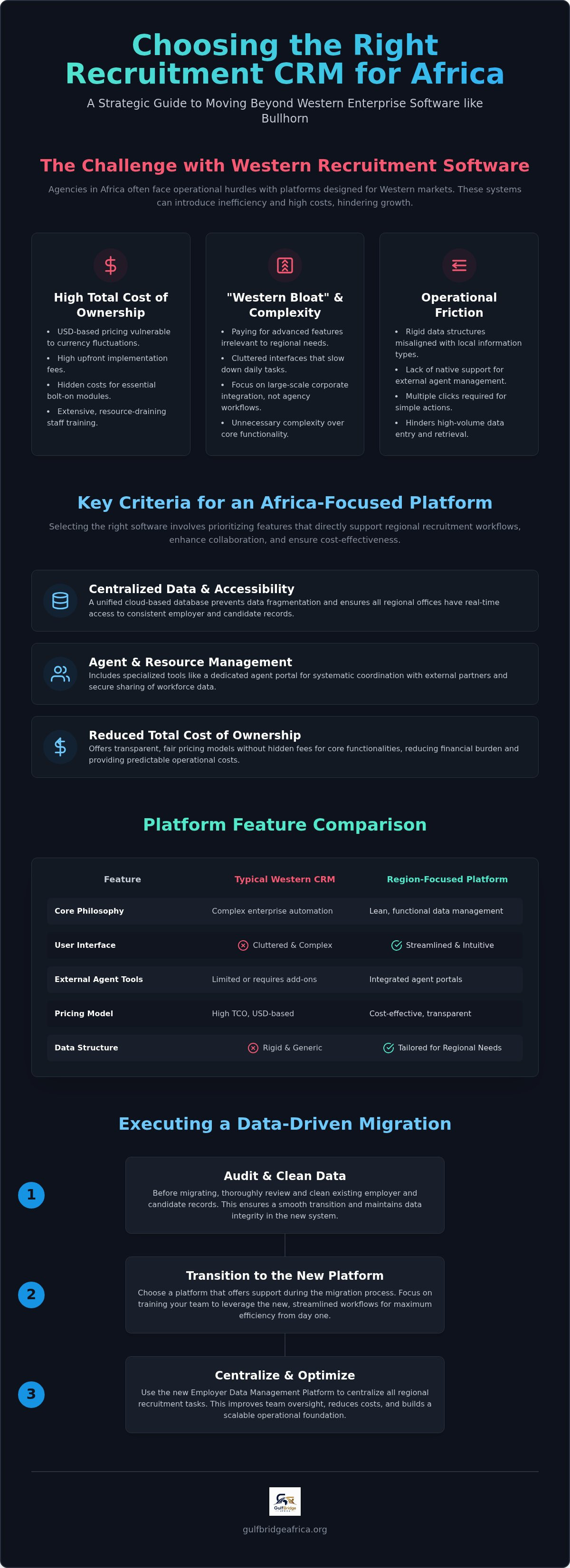
Bullhorn functions as an enterprise-level recruitment CRM designed for Western market structures. It prioritizes complex automation and large-scale corporate integration. African agencies frequently encounter "Western bloat" within this framework. This term describes paying for advanced features that local teams rarely use. These redundant tools complicate the user interface and slow down administrative tasks. Agencies searching for Bullhorn alternatives for Africa require a system focused on core administrative tasks and regional operational reality.
The Total Cost of Ownership (TCO) Problem
Pricing for Western software follows a USD-based model. This creates financial instability for African firms during periods of currency fluctuation. Monthly subscription costs change significantly in local terms. Upfront implementation fees also represent a high entry barrier for many agencies. Subscription tiers often require additional bolt-on modules to access basic reporting or integration tools. These hidden costs extend to staff training requirements. Complex systems require long onboarding periods. This diverts resources from core recruitment activities and increases the total cost of ownership over time.
Operational Friction in Regional Workflows
The standard Bullhorn interface lacks the flexibility needed for regional data handling. It uses rigid structures for employer and candidate records. These structures do not always match the data types required by local manpower agencies. There is a noticeable lack of native support for external agent management. This is a significant limitation for teams working to mitigate the youth employment crisis in Africa. Efficient recruitment requires tools that handle diverse data points without error.
A functional, lean interface allows for faster data entry and retrieval. High output relies on a system that removes navigational friction. Standard Western software often requires multiple clicks to perform basic tasks like updating a job status or viewing agent notes. Systematic organization is better achieved through specific operational improvements:
- Direct data entry fields tailored to regional requirements.
- Cloud-based accessibility that remains stable across different regional offices.
- Simplified navigation that mirrors the logic of a recruitment workflow.
- Administrative oversight tools that track agent performance.
Removing these operational hurdles ensures that teams remain focused on candidate placement. A streamlined system prioritizes task completion over software complexity. This approach creates a reliable framework for regional recruitment teams to manage high volumes of data efficiently.
Key Criteria for Selecting Recruitment Software in Africa
Agencies must evaluate software based on operational utility rather than marketing features. Effective Bullhorn alternatives for Africa prioritize reliability and regional accessibility. The selection process focuses on how the system handles high-volume data across distributed teams. Systematic organization requires a platform that supports the specific needs of manpower agencies. Identifying Bullhorn alternatives for Africa involves looking for systems that simplify complex administrative tasks and provide clear oversight of regional operations.
Data Organization and Accessibility
A centralized employer database ensures consistent record keeping across all regional offices. This structure prevents data fragmentation and reduces administrative errors. Cloud storage is essential for teams operating in different African cities. It allows remote recruitment agents to access real-time information without hardware limitations. The system's functional design should prioritize rapid scanning. Users need to identify key candidate or employer details immediately. Task completion becomes faster when the interface follows a logical, subject-action-result format. Efficient employer data management provides the foundation for scalable recruitment operations. Reliable data access reduces the time spent on manual record verification.
Agent and Resource Management
Managing external partners requires specific functionality often missing from Western enterprise tools. A dedicated agent resource portal allows for systematic coordination with third-party recruiters. This portal acts as a secure environment for sharing workforce data. Collaborative tools must allow for secure sharing of candidate and employer data among team members. Integrated tools for recruitment flyers help agents market vacancies effectively. These flyers provide a standardized way to communicate job requirements. Agents use these assets to market positions effectively within their local networks. This integrated approach ensures that job posting services remain synchronized with agent efforts across various regions.
Software evaluation should also assess the ability to manage multiple data types. A robust platform handles employer profiles, agent credentials, and candidate records within a single framework. Systematic vacancy management requires integrated job posting tools. These tools allow teams to distribute job details across multiple channels from one central interface. Collaborative features allow regional offices to share workforce data securely. This visibility improves team coordination and reduces redundant communication. Selecting a platform based on these criteria ensures long-term operational efficiency. It moves the focus from software maintenance to active recruitment and placement. A utilitarian platform serves as a silent partner in the daily workflow.
Top Bullhorn Alternatives for African Manpower Agencies
Selecting a recruitment platform requires balancing functional requirements with budget constraints. Several Bullhorn alternatives for Africa provide the necessary tools for regional data management without the complexity of enterprise systems. These platforms range from specialized regional tools to established global systems with localized footprints. Agencies must identify which system best supports their specific administrative workflow and regional office coordination.
Regional Specialist: GulfBridge Africa
GulfBridge Africa provides a specialized employer data management system for agencies operating within the continent. The platform eliminates enterprise bloat. It prioritizes the core administrative tasks required by manpower agencies. Users gain access to a utilitarian interface designed for organizing, tracking, and sharing candidate data. This focus on operational efficiency ensures that teams spend less time on software configuration. The system remains stable in regional environments where accessibility is a priority. It functions as a silent partner in the recruitment workflow by providing a structured framework for daily tasks.
Global Contenders with African Footprints
Zoho Recruit serves as a budget-friendly entry point for smaller recruitment teams. It offers a scalable structure that grows with the agency's requirements. Localized support is available in specific African regions to assist with setup and troubleshooting. The platform handles basic ATS and CRM functions within a unified interface.
Recruiterflow is an option for agencies that prioritize automated outreach sequences. It starts at $149 per user per month as of August 2026. This platform uses automation to manage candidate matching and communication patterns. It reduces the manual effort needed for initial engagement. Teams use it to maintain consistent contact with candidate pools without increasing administrative headcount.
Vincere, now part of Access Vincere Evo, starts from £85 per user per month. It provides heavy back-office integration and advanced analytics. This system suits firms that require deep reporting on financial performance and placement metrics. It handles the complexities of temporary and permanent placement tracking within one system.
JobAdder is recognized for its clean user interface and job board distribution capabilities. It simplifies the process of posting vacancies across multiple regional platforms. The UX focuses on reducing the number of clicks required for standard tasks. Other options include Recruit CRM, starting from €95 per user per month, and Loxo, beginning at $119 per user per month. Both platforms integrate essential data handling tools into a single dashboard. Assessing these Bullhorn alternatives for Africa ensures that the chosen tool aligns with local operational realities and systematic management goals.
How to Migrate from Bullhorn to a Regional System
Migration is a technical process. It requires systematic planning to ensure data integrity. Agencies moving to Bullhorn alternatives for Africa must follow a structured transition plan. This plan begins with a thorough audit of the existing database. Identify all active employer and candidate records. Determine which data points are essential for ongoing operations. Clean the database to remove redundant or obsolete information. High-quality data migration prevents future administrative errors and ensures the new system remains efficient from day one.
Mapping existing fields is a critical step. Use the logic of manpower agency management software Africa to align Bullhorn's data structure with the new platform. This alignment ensures that search filters and reporting tools function correctly after the move. Conduct a pilot migration with a small data set of 10 to 20 records. This test verifies that field mapping is accurate. It allows the team to identify and correct errors before the full database is transferred. Verification at this stage prevents large-scale data corruption during the final bulk upload.
Data Cleaning and Field Mapping
Identify custom fields in Bullhorn that require specific placement in the new system. These fields often contain critical regional data like agent notes or specific compliance documents. Remove duplicate employer records to maintain a clean centralized database. This process reduces the risk of fragmented communication with clients. Ensure all recruitment agent documentation is prepared for bulk upload. Systematic preparation reduces the time needed for the final transition. Clean data allows Bullhorn alternatives for Africa to operate at peak performance immediately after implementation.
Training and Implementation
Schedule short, functional training sessions for the team. Base these sessions on specific team roles to ensure immediate utility. Recruiters require different instructions than administrative staff or regional managers. Update internal SOPs to reflect the new streamlined recruitment workflow. This documentation provides a reliable reference for the team during the transition period. Use a phased rollout to minimize disruption to active job postings. Start with a single department to test the new workflow before expanding to the entire agency. You can utilize the Employer Data Management Platform to begin organizing your regional records for a seamless transition. A structured approach to training ensures that all users understand the primary purpose of each interaction within the new platform.
Optimizing Workflows with GulfBridge Africa’s Management Tools
Operational efficiency requires a system that removes administrative friction. GulfBridge Africa provides a structured environment for managing high-volume recruitment data across diverse territories. Agencies evaluating Bullhorn alternatives for Africa often prioritize tools that handle regional complexities without unnecessary software bloat. Systematic workflow optimization begins with centralizing all recruitment assets into a single cloud-based framework. This approach ensures that data remains accessible to all authorized team members regardless of their physical location. Using a utilitarian system allows agencies to maintain professional standards while reducing the time spent on manual data entry.
Centralizing Employer and Agent Data
Maintaining a single source of truth prevents data silos and administrative errors. The Employer Data Management Platform allows for the systematic entry and retrieval of client records within a standardized interface. Users can track agent progress and resource usage through the Agent Resource Portal. This oversight ensures that external partners align with the agency's operational standards. GulfBridge Africa is a utilitarian cloud platform for regional data management. A centralized database reduces the time spent on manual record verification and cross-referencing. This organization facilitates faster decision-making across regional offices by providing immediate access to verified data points.
Managing Recruitment Campaigns
Standardizing marketing assets improves the consistency of recruitment outreach. Agencies use integrated Recruitment Flyers to provide agents with uniform job details. These digital flyers ensure that vacancies are marketed correctly within local networks and social channels. The Job Posting Service allows teams to manage vacancies across multiple regions from one central interface. Tracking the performance of job listings helps optimize recruitment spend by identifying high-yield channels and regions. Real-time data tracking ensures that all team members remain aligned on active campaign statuses and candidate volumes. This visibility allows for immediate adjustments to recruitment strategies based on live data.
Cloud-based data sharing tools streamline collaboration between regional offices. Team members access updated candidate and employer records instantly without the need for manual file transfers. This visibility reduces redundant communication and prevents task duplication within the team. Streamlined workflows allow recruitment teams to focus on core placement activities rather than software maintenance. Utilizing these specialized tools provides a reliable framework for managing complex regional operations. Systematic organization leads to improved oversight and consistent professional outcomes. The transition to Bullhorn alternatives for Africa results in a leaner, more responsive recruitment operation that is better suited to the regional market's practical demands.
Transitioning to Regional Operational Excellence
Transitioning to a regional management system reduces the operational friction caused by enterprise-level software bloat. You've identified the high costs and complex interfaces associated with Western platforms. Selecting Bullhorn alternatives for Africa allows your team to focus on systematic data organization and regional collaboration. Migration requires a structured approach to data cleaning and field mapping to ensure record integrity. A functional platform provides the stability needed for high-volume recruitment across multiple African offices. Systematic organization remains the key to scalable growth.
GulfBridge Africa offers a specialized framework for regional data management. The platform provides cloud-based accessibility for African teams and includes integrated agent resource tools for better coordination. You can centralize employer records and streamline vacancy management through a single administrative interface. These tools provide a reliable framework for your daily workflow without unnecessary technical complexity. Streamline your agency operations with GulfBridge Africa to improve your team's oversight and administrative output. Implementing a lean, functional system ensures your agency remains competitive and organized in the 2026 recruitment landscape.
Frequently Asked Questions
What are the main reasons to switch from Bullhorn to an alternative in Africa?
High implementation fees and USD-based pricing are the primary drivers for this transition. Western enterprise software often includes features that African agencies do not use, leading to unnecessary operational complexity. Clunky interfaces slow down local teams and lack specialized tools for managing external recruitment agents. Switching to Bullhorn alternatives for Africa allows agencies to lower their total cost of ownership while using a platform designed for regional operational realities and systematic data management.
Is GulfBridge Africa suitable for small manpower agencies?
The platform supports both teams and solo users through a scalable cloud-based structure. It provides a utilitarian interface for organizing and tracking work without the technical complexity of enterprise systems. Small agencies use the Employer Data Management Platform to maintain professional records and the Job Posting Service to manage vacancies. This modular approach allows smaller firms to access professional data management tools and agent resource portals without paying for redundant enterprise features.
How does Bullhorn pricing compare to regional recruitment software?
Bullhorn follows a USD-priced tiered model. As of August 2026, the Starter tier costs $99 per user per month and the Core tier is $165 per user per month. Regional alternatives provide more predictable costs by focusing on core functionality rather than expensive bolt-on modules. High implementation fees for global software represent a significant entry barrier. Regional systems reduce the total cost of ownership by eliminating enterprise bloat and streamlining the onboarding process for local teams.
Can I manage external recruitment agents using these alternatives?
Specialized Bullhorn alternatives for Africa include dedicated tools for agent coordination. GulfBridge Africa provides an Agent Resource Portal where agencies track agent progress and resource usage. This system allows for the secure sharing of candidate and employer data among team members and external partners. Digital recruitment flyers also help agents market vacancies effectively within their local networks. These features ensure that external recruitment efforts remain synchronized with the central agency and administrative goals.
What is the best way to handle employer data management in Africa?
Centralizing all records within a cloud-based Employer Data Management Platform is the most effective method. This approach ensures a single source of truth for all employer information and prevents data fragmentation across regional offices. A functional design allows for rapid data entry and retrieval, which is essential for high-volume recruitment. Systematic organization improves team oversight and reduces administrative errors. Maintaining clean, centralized data supports better collaboration and long-term operational efficiency for regional manpower agencies.
Do Bullhorn alternatives support job postings on African job boards?
Most regional platforms include integrated job posting services that distribute vacancies across multiple channels. These systems allow teams to publish and manage job listings from one central interface. Some alternatives also provide digital flyers that agents use to market positions on local social networks and job boards. This integrated approach ensures that vacancy details remain consistent across all platforms. Tracking the performance of these listings helps agencies optimize their recruitment spend and identify high-yield regional channels.
Is cloud storage secure for sensitive recruitment data in Africa?
Cloud-based recruitment platforms utilize standard security protocols to protect sensitive employer and candidate data. These systems provide a more secure environment than manual record-keeping or fragmented local storage. Access controls allow agencies to manage which team members can view specific data points. Regular backups and encrypted data transfers ensure that information remains protected across regional offices. Utilizing a professional data management platform helps agencies maintain compliance with regional data protection standards and ensure systematic record security.


