

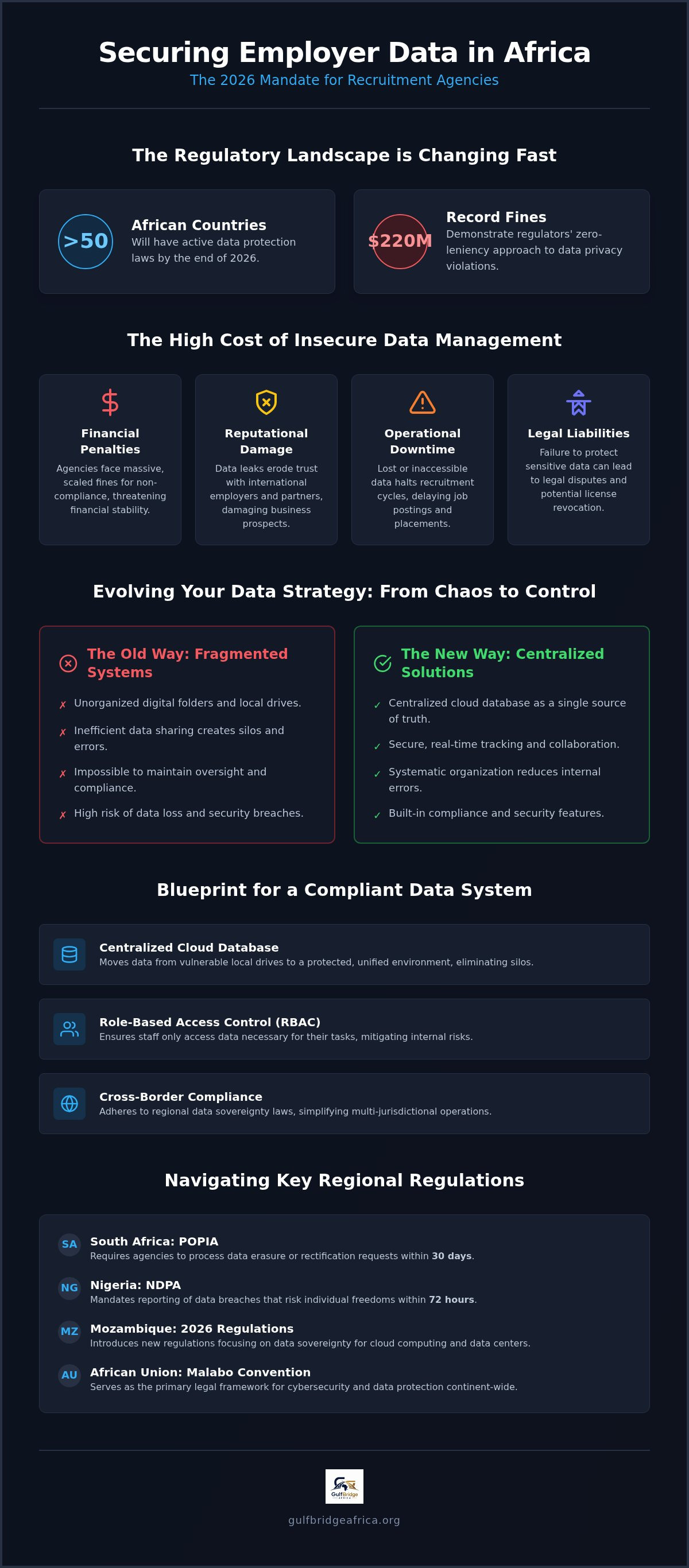
By the end of 2026, more than 50 African countries will have active data protection laws. Regulators are moving toward a zero-leniency policy, as demonstrated by the $220 million fine recently issued in Nigeria. Implementing secure employer data storage solutions Africa requires a structured operational framework rather than simple file storage. Unorganized digital folders and inefficient data sharing create significant risks for data loss and legal liability.
You likely find that fragmented systems make it difficult to maintain compliance with regional acts like POPIA or Ghana's updated data protection fee schedules. This guide delivers a systematic analysis of cloud-based storage requirements and operational protocols for recruitment agencies. We'll review the implementation of centralized databases and secure, role-based access for agents and staff. This information provides the necessary framework to align your daily workflow with both local and international data standards.
Key Takeaways
- Transition from fragmented digital folders to centralized cloud databases to mitigate data loss and improve operational oversight.
- Implement role-based access control (RBAC) to ensure sensitive employer information is only accessible to authorized personnel.
- Evaluate the cost and speed advantages of secure employer data storage solutions Africa compared to maintaining on-premise hardware or physical records.
- Execute a systematic data audit to identify current storage locations before migrating information to a secure SaaS environment.
- Utilize integrated platforms to manage job postings and agent resources within a single, compliant interface.
The Operational Necessity of Secure Employer Data Storage in Africa
In 2026, the transition from decentralized file-sharing to centralized cloud databases is a functional necessity. Recruitment agencies manage high volumes of sensitive employer and candidate information. This concentration of data makes them high-value targets for digital breaches. Using secure employer data storage solutions Africa provides the structure needed to mitigate these risks through systematic organization. Centralizing these assets moves data away from vulnerable local drives and into protected cloud environments.
Chaotic digital environments lead to internal errors and external vulnerabilities. When data is scattered across multiple team members' devices, oversight becomes impossible. The African Union Convention on Cyber Security and Personal Data Protection serves as the primary legal framework for these standards. It mandates that organizations treat data as a sovereign asset. Agencies must adopt systematic protocols to ensure every record follows a secure operational path from entry to archival. Systematic organization is a security feature that reduces the surface area for potential leaks.
Regional Regulatory Landscape for 2026
Compliance requirements vary by country but follow a trend toward stricter enforcement. South Africa's POPIA is fully operational. It requires agencies to process data erasure or rectification requests within 30 days. In Nigeria, the NDPA and the 2026 National Digital Economy and E-Governance Bill establish clear reporting timelines. Mozambique also implemented new data center and cloud computing regulations in March 2026, focusing on data sovereignty. These laws require data controllers to report breaches within 72 hours if they risk individual freedoms.
Cross-border data transfer regulations significantly impact manpower agencies. Moving worker data between African nations requires adherence to regional sovereignty laws. Standardized data protection frameworks are emerging to simplify these transfers. These frameworks allow agencies to maintain a single set of security protocols across different regional offices. It reduces the administrative burden of managing multiple compliance checklists. Secure employer data storage solutions Africa help agencies navigate these requirements by providing a unified platform for multi-jurisdictional data handling.
Consequences of Insecure Data Management
Financial risks are substantial in the current regulatory environment. Regulators have demonstrated a zero-leniency approach. For example, the Nigeria Data Protection Commission and the FCCPC recently issued a $220 million fine against Meta for data privacy violations. Agencies that fail to secure employer information face similar scaled penalties. Reputational damage often follows these leaks, leading to a loss of trust from international employers and partner agents.
Operational downtime is a direct result of unorganized records. When data is lost or inaccessible, recruitment cycles stop. Agents can't share resources, and job postings are delayed. Legal liabilities are particularly high for agencies handling migrant worker data. This sensitive information requires specific protections under modern cybersecurity laws. Failure to implement secure storage leads to protracted legal disputes and potential license revocation. Maintaining a structured database is the only way to ensure continuous operation and legal safety.
Functional Requirements for an Employer Data Management System
An Employer Data Management System is a centralized SaaS platform designed for the storage, tracking, and sharing of employer information. Modern secure employer data storage solutions Africa utilize multi-tenant cloud storage architectures. This structure allows multiple agencies to operate on shared infrastructure while maintaining total data isolation. Each agency's data remains logically separated from others. Role-based access control (RBAC) is a critical requirement for recruitment teams. RBAC ensures that staff members only access data necessary for their specific tasks. Admin-level users can restrict access to sensitive employer financial data or contract terms. This limits the internal risk of unauthorized data exposure across the team.
Centralized Database vs. Fragmented Storage
Localized folder structures fail in collaborative recruitment environments. They create data silos and lead to version control errors. When files exist only on individual computers, team coordination breaks down. A centralized employer database enables real-time tracking across the organization. It allows for the systematic categorization of data types. These include employer profiles, active vacancies, and agent resources. Centralization ensures that all team members work from a single source of truth. This increases operational efficiency and reduces the time spent searching for misplaced files. It also ensures that employer updates are visible to all agents instantly.
Security Protocols for Cloud-Based SaaS
Cloud-based systems must implement high-level security protocols to protect sensitive documentation. End-to-end encryption standards are mandatory for all recruitment data. This ensures that information remains unreadable during transfer and at rest. Automated backups and disaster recovery protocols prevent permanent data loss during system failures. Adopting secure employer data storage solutions Africa through a SaaS model provides these protections by default. As data privacy frameworks in Africa continue to evolve, these technical safeguards become legal necessities. Agencies must verify that their storage providers offer regional server options to comply with data sovereignty laws.
Activity logging provides oversight of recruitment workflows. It records every instance of data access or modification. This creates an auditable trail for compliance purposes. Integrating job posting tools within the core environment further secures the workflow. It eliminates the need to export sensitive data to external third-party services. Managing these functions within a single platform maintains a closed security loop. Agencies can explore these integrated features through the Employer Data Management Platform to streamline their internal processes. This unified approach reduces the risk of data leakage during the job distribution phase.
Evaluating Storage Methods: Physical vs. Cloud vs. SaaS
Selecting the correct storage architecture determines the speed of agency operations. Physical records provide the slowest accessibility speeds. Finding a specific employer file in a physical archive often takes several minutes or hours. Digital platforms deliver results in seconds. Implementing secure employer data storage solutions Africa requires moving away from these legacy systems to improve response times. On-premise servers require significant upfront capital for hardware and cooling. They also require ongoing costs for specialized IT staff. SaaS subscriptions replace these capital expenditures with predictable monthly operational costs. This shift allows agencies to allocate resources toward core recruitment activities.
The Limitations of Physical Document Storage
Physical filing involves high operational costs. Agencies must pay for storage space, transport, and facility maintenance. These records are also vulnerable to environmental damage and theft. Paper-based employer records lack the encryption levels found in digital systems. Unauthorized access is harder to track without digital logs. Inefficiency is a major drawback when updating or sharing job vacancy data. It requires manual re-entry and physical distribution to agents. This delay slows down the recruitment cycle and reduces the agency's competitiveness.
The Efficiency of Specialized SaaS Platforms
SaaS platforms provide immediate access to manpower agency management software Africa. This allows for real-time updates across the entire organization. Tiered subscription models lower entry costs for smaller agencies. These platforms include built-in collaborative tools. Teams don't need third-party file-sharing services. This reduces the risk of data leaks during the transfer process. A specialized SaaS environment ensures that all data remains within a controlled security perimeter. Every action is logged and auditable.
Storage systems must grow with agency volume. Physical systems require more floor space as data increases. SaaS platforms scale automatically based on data usage. This is a functional advantage for remote recruitment agents across Africa. Agents can access the central database from any location with internet connectivity. It ensures that the recruitment workflow remains consistent regardless of the agent's physical office. Using secure employer data storage solutions Africa through a SaaS provider ensures that security updates are applied automatically. This removes the burden of manual maintenance from the agency staff. The result is a more resilient and scalable data environment.
Implementing Secure Data Workflows for Recruitment Agencies
Establishing operational security requires a five-step implementation process. Organizations must first audit current employer data types and storage locations. This step identifies information stored on local drives, email servers, or physical cabinets. Second, migrate sensitive information to a secure SaaS environment. Transitioning to secure employer data storage solutions Africa protects data through encryption during and after the move. Third, define access levels for internal staff and external recruitment agents. Use role-based permissions to restrict sensitive employer legal documents to senior administrators only. Fourth, standardize job posting and document sharing protocols. This ensures all agents use uniform templates and distribution channels. Finally, conduct regular system audits. These reviews verify that data integrity remains intact and access logs show no unauthorized activity.
Managing Multiple Employer Data Types
Recruitment agencies handle diverse data sets that require specific storage protocols. Store employer contact details and legal documentation in highly restricted, encrypted zones. Systematic handling of job vacancy listings and recruitment marketing assets allows for broader team access. These assets facilitate the daily recruitment cycle. Manage digital recruitment flyers and agent portals within the same platform to maintain version control. This prevents agents from using outdated job specifications or incorrect employer requirements. Centralizing these resources ensures that every team member accesses the same verified information. You can implement these workflows using the Employer Data Management Platform to consolidate your agency assets.
Collaborative Data Sharing Protocols
Safe data sharing is critical when coordinating with field agents. Avoid using unencrypted email attachments for sharing employer requirements. Instead, provide agents with secure links to the centralized database. This method allows the agency to track recruitment progress online in real-time. Team coordination follows a subject-action-result format to maintain clarity. For example, an agent selects a vacancy, uploads a candidate, and records the employer's response. This structure provides immediate visibility into the status of every job order. It eliminates the need for repetitive status meetings or manual spreadsheets. Maintaining these protocols reduces the risk of data leakage while increasing the speed of the recruitment process. Every interaction within the system creates an auditable record of the agency's operational flow.
GulfBridge Africa: Centralized Data Management for Modern Agencies
GulfBridge Africa provides a cloud-based Employer Data Management Platform. It functions as a structured tool for African recruitment agencies. The platform centralizes sensitive employer information into a single, accessible environment. This architecture supports secure employer data storage solutions Africa by removing reliance on fragmented local storage. Agencies utilize the Job Posting Service to distribute vacancies across multiple channels from one interface. This systematic approach ensures that data remains within the agency's controlled environment. The platform maintains a neutral, professional distance while providing the necessary framework for daily operations.
Operational Tools for Recruitment Teams
The platform organizes, tracks, and shares work in a single location. Recruitment teams manage job vacancies and Recruitment Flyers using integrated tools. This eliminates the need for external design or file-sharing software. The Agent Resource Portal provides a framework for systematic oversight of field personnel. Admins assign specific access levels to ensure that agents only view relevant employer data. This role-based access maintains the security protocols required for regional compliance. Coordination within the platform follows a logical, task-oriented flow. Team members upload employer requirements, generate flyers, and track application progress. Every action results in an updated record within the centralized database. This consistency prevents the data silos often found in decentralized agencies.
Reliability and Systematic Logic
GulfBridge Africa prioritizes utilitarian design. The interface mirrors the logic of professional recruitment tasks. It avoids marketing hyperbole and high-energy persuasion. Instead, the system emphasizes professional data handling and team coordination. A SaaS subscription model allows agencies to scale their access as their volume grows. This ensures that secure employer data storage solutions Africa remain accessible for agencies of all sizes. The platform acts as a silent, reliable partner in the agency's daily workflow. It focuses entirely on the utility of data management rather than brand personality. This projects an image of stability and systematic logic for users who value organization.
Implementing the platform for your agency’s workflow is a sequential process. Admins set up the centralized database and migrate existing employer records. They then configure agent permissions within the portal. This systematic setup creates a stable environment for long-term operations. The platform provides the necessary framework for work without demanding the spotlight. It remains a structured tool designed to bring order to the professional recruitment environment. Every feature is selected to describe a specific function or a clear organizational outcome. This creates a rhythmic pattern of completion and progress in the user's daily tasks.
Standardizing Your Agency’s Data Infrastructure for 2026
Transitioning to a centralized SaaS model allows agencies to meet regional regulatory demands while improving team coordination. The shift from physical or fragmented digital storage to structured databases eliminates operational bottlenecks and prevents data loss. Implementing role-based access ensures that sensitive employer information remains protected from unauthorized internal or external exposure. These systematic changes move your agency away from reactive data handling and toward a proactive security posture. Every record in your system must follow a documented path from entry to archival to ensure total compliance.
Adopting secure employer data storage solutions Africa provides the stability required for scalable growth in a maturing digital economy. You can now access the GulfBridge Africa Employer Data Management Platform to implement these operational standards. The system uses cloud-based operational logic and integrated agent resource tools to maintain a secure recruitment environment. It's designed to function as a silent partner in your daily workflow, focusing entirely on task management and organizational utility. Establishing these protocols today ensures your agency remains compliant and efficient as regional data standards continue to evolve across the continent.
Frequently Asked Questions
What makes a data storage solution secure for African employers?
A secure solution combines end-to-end encryption with strict compliance to regional acts like POPIA and NDPA. It requires role-based access control to ensure that only authorized personnel interact with sensitive records. Secure employer data storage solutions Africa must also provide automated backups and activity logging. These features create an auditable trail of all data interactions. This systematic approach reduces the risk of internal leaks and external breaches within the recruitment workflow.
How do SaaS subscriptions improve recruitment agency data management?
SaaS subscriptions replace high upfront hardware costs with predictable monthly operational expenses. This model allows agencies to scale their storage capacity as their employer database grows. The platform provider manages all security updates and system maintenance automatically. This ensures the agency always operates on the most current software version. It removes the burden of IT management from recruitment staff. Teams focus entirely on their core administrative tasks and systematic organization.
Can I manage multiple types of employer data on a single platform?
Yes, centralized platforms allow for the management of employer contact details, legal contracts, and job vacancy listings in one location. You can also store recruitment marketing assets like digital flyers and agent resource documents. This integration prevents data fragmentation across different software tools. Every team member accesses a single source of truth for all employer-related information. This structure improves the speed of data retrieval and ensures version control across the entire organization.
Is cloud storage more reliable than physical record-keeping in Africa?
Cloud storage is more reliable due to its resilience against environmental damage, theft, and physical degradation. Unlike paper files, digital records are accessible to remote agents across different regions instantly. Automated disaster recovery protocols ensure that data remains intact even during local hardware failures. Physical records require significant floor space and manual transport, which increases operational costs. Digital systems provide a more stable and scalable framework for managing high-volume recruitment data in 2026.
What are the key features of an employer data management system?
Key features include a centralized employer database, role-based access control, and integrated job posting tools. A functional system also provides an Agent Resource Portal for oversight of field staff. Integrated tools for creating Recruitment Flyers allow teams to generate marketing assets directly from stored job data. Activity logging and encrypted file sharing are essential for maintaining security. These features work together to create a streamlined, task-oriented environment for recruitment professionals and their partners.
How does centralized data storage assist in recruitment agency collaboration?
Centralized storage enables real-time data sharing between internal staff and external agents. It eliminates the need for sending sensitive employer requirements via unencrypted email attachments. Team members track recruitment progress within a shared interface using a subject-action-result format. This provides immediate visibility into the status of every job order. Collaborative oversight ensures that all agents follow the same standardized protocols. This reduces communication errors and increases the overall efficiency of the recruitment cycle.
What security standards should I look for in an African recruitment platform?
Look for platforms that implement AES-256 encryption for data at rest and TLS for data in transit. The provider should offer regional server options to comply with emerging data sovereignty laws in countries like Nigeria and Mozambique. Secure employer data storage solutions Africa must include multi-factor authentication and regular system audits. Verify that the platform aligns with the African Union Convention on Cyber Security. These standards ensure that the platform handles sensitive data professionally and legally.
How does GulfBridge Africa protect sensitive employer information?
GulfBridge Africa protects information through a cloud-based operational logic that prioritizes data isolation. The platform uses multi-tenant architecture to keep each agency's data strictly separated. Sensitive records are protected by role-based access levels that admins define for their specific teams. All transfers are encrypted to prevent unauthorized interception. The system maintains detailed activity logs to provide a transparent record of all data modifications. This creates a secure, neutral environment for professional data management and team coordination.


