

The global cloud computing market is valued at $917.9 billion in 2026, with 94% of enterprises now utilizing these systems for core operations. Despite this widespread adoption, many recruitment teams continue to face disorganized employer records and inconsistent job vacancy management. It's difficult to track recruitment agent progress when data remains scattered across multiple offline spreadsheets or legacy systems. You need a structured environment where information is accessible and oversight is constant to maintain operational stability. Using the right cloud tools for manpower agencies is the first step toward achieving this systematic order.
This article provides a systematic review of operational tools designed to resolve these specific administrative challenges. We focus on functional platforms that organize employer data and streamline recruitment workflows through centralized management. You'll learn how consolidated data improves collaboration with agents and facilitates faster candidate matching. This roundup covers the current operational landscape of 2026, including specialized platforms for job posting and data handling. We examine how these systems provide the necessary framework for systematic growth and efficient task management without the complexity of unintegrated software.
Key Takeaways
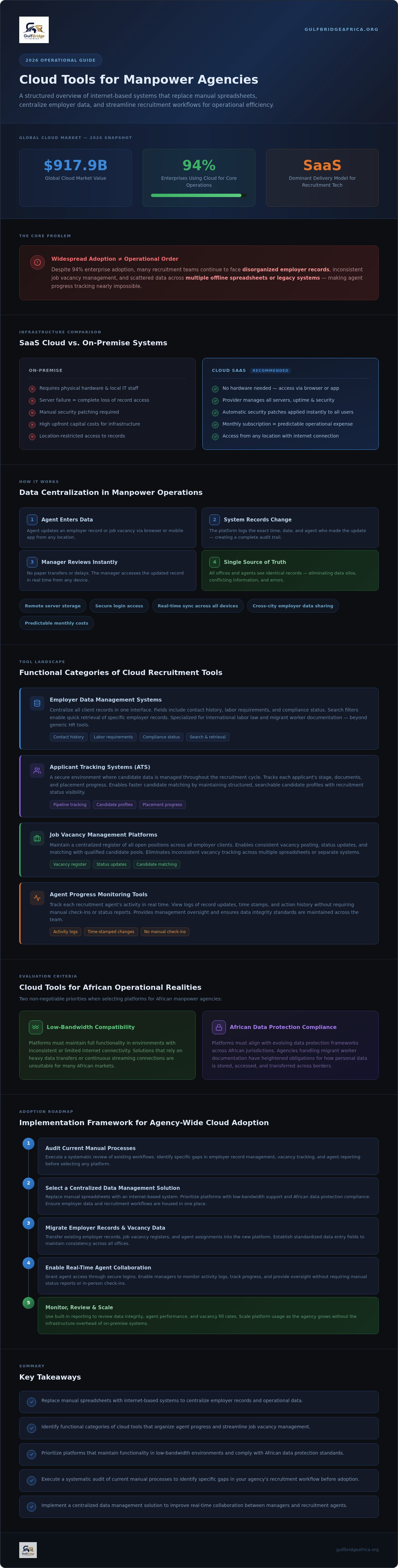
- Replace manual spreadsheets with internet-based systems to centralize employer records and operational data.
- Identify functional categories of cloud tools for manpower agencies that organize agent progress and streamline job vacancy management.
- Prioritize platforms that maintain functionality in low-bandwidth environments and comply with evolving African data protection standards.
- Execute a systematic audit of current manual processes to identify specific gaps in your agency's recruitment workflow before adoption.
- Implement a centralized data management solution to improve real-time collaboration between managers and recruitment agents.
Understanding Cloud Infrastructure for Manpower Agencies
Cloud tools for manpower agencies are internet-based systems designed to manage operational data. These platforms replace local storage and manual spreadsheets with a digital environment. Users access these services through a web browser or mobile application. This setup ensures that data remains available as long as an internet connection exists. Agencies transition from paper logs to digital entries to improve speed. The system records the entry. The manager reviews the entry immediately. This workflow removes the delays associated with physical document transfers.
Most modern recruitment technology uses the Software-as-a-Service (SaaS) model. Agencies pay a monthly subscription fee to access the platform. This model removes the need for expensive upfront costs associated with server hardware. It allows small teams and large agencies to utilize the same high-level infrastructure. The provider hosts the software on their own servers. The user pays for the utility. This creates a predictable operational expense for the agency budget.
SaaS vs. On-Premise Systems for Recruitment
On-premise systems require physical hardware and local maintenance. This creates a reliance on internal IT staff for troubleshooting and security. If a local server fails, the agency loses access to its records. In contrast, cloud SaaS models eliminate the need for local IT infrastructure. The service provider manages the servers and data centers. Automatic updates ensure the agency uses the latest security features without manual intervention. This structure supports a secure Applicant Tracking System (ATS) environment where data protection is handled by the service provider. Security patches apply instantly to all users.
The Role of Data Centralization in Manpower Operations
Centralized databases allow teams to access information from any location. This centralization prevents data silos between different recruitment teams. When information is stored in one place, every agent sees the same records. A single source of truth reduces errors in employer record management. Cloud systems facilitate employer data sharing across regional offices. This ensures that an agent in one city can view the same job vacancy details as a manager in another. Implementing these cloud tools for manpower agencies ensures that data remains consistent across the entire organization.
- Operational data is stored on remote servers for permanent access.
- Teams access records through secure logins to maintain privacy.
- Subscription models provide predictable monthly costs for better budgeting.
- Data remains synchronized across all user devices in real time.
Centralization also simplifies the tracking of recruitment agent progress. Managers view activity logs to see which agents are updating records. The system tracks the time and date of every change. This oversight ensures that the agency maintains a high standard of data integrity. It removes the need for manual check-ins or status reports. The data provides the status automatically.
Functional Categories of Cloud Recruitment Tools
Operational efficiency in recruitment depends on the categorization of administrative tasks. Different cloud tools for manpower agencies serve specific roles within the recruitment cycle. These tools organize employer data, facilitate team updates, and monitor placement progress. Using a modular system allows agencies to replace manual oversight with automated tracking. Each category provides a specific framework for handling high volumes of information. This systematic approach ensures that every stage of the recruitment process remains visible and manageable.
Employer Data Management Systems
Manpower agencies must handle diverse data points for international clients. Effective systems manage multiple employer data types systematically within a single interface. Database fields include contact history, specific labor requirements, and compliance status. Search filters allow for the quick retrieval of specific employer records. This prevents the loss of information common in paper-based systems. While general business solutions exist, as seen in Forbes Advisor's Best Cloud HR Software, agencies require specialized fields for labor laws and migrant worker documentation. The data remains secure and accessible to authorized personnel only.
Recruitment Agent Resource Portals
Portals provide agents with access to shared documentation and active job listings. Managers use these tools to manage manpower agency data across decentralized networks. Agents log in to view current vacancies. They submit candidate data directly to the cloud database. This collaborative feature removes the need for email attachments. It ensures that the central database updates in real time. Managers track agent progress through activity logs. This oversight maintains a consistent standard of data entry across the entire team. The portal acts as a central hub for all agent interactions.
Job Vacancy and Listing Services
Cloud portals allow for the immediate publication of new job roles. Integrated tools help track the volume of applications per vacancy. This data allows managers to reallocate resources to urgent roles. Digital flyer tools assist in promotional efforts by generating recruitment assets. These assets are shared with agents for distribution. Rapid publication leads to faster candidate matching. Agencies can utilize the Employer Data Management Platform to consolidate these recruitment assets and vacancy listings in one location. This centralization simplifies the workflow for both managers and agents.
- Data Management: Organizes employer records and compliance documents.
- Communication: Provides real-time updates between managers and agents.
- Tracking: Monitors application volumes and placement status.
- Marketing: Generates digital recruitment flyers for vacancy promotion.
Evaluating Cloud Tools for African Operational Realities
US-based manpower agencies managing recruitment or operations in diverse global regions, particularly Africa, encounter unique infrastructure considerations that influence software selection. While their primary operations are in the US, ensuring seamless functionality for international teams requires foresight. Connectivity and hardware variations across different locations, including parts of Africa, necessitate cloud tools for manpower agencies that are robust and adaptable. The goal is to maintain data integrity and operational efficiency across all touchpoints, regardless of regional infrastructure differences. Reliability and adaptability are paramount for US agencies overseeing complex international recruitment workflows.
Regional Data Access and Connectivity
For US agencies with international teams, especially those in regions with varying internet stability, software performance often hinges on its resource demands. Selecting cloud tools with light browser requirements ensures consistent performance, even on older hardware or slower networks commonly found in some international locations. This guarantees a quick and responsive interface for every global user. Crucially, offline data entry options are vital to prevent work loss during temporary connectivity drops. Such systems save data to a local cache and synchronize with the cloud once the connection is restored. Furthermore, cloud servers must guarantee reliable uptime for all users, including those in African regions. Frequent downtime disrupts the global recruitment cycle, making constant access a functional necessity for professional data handling across borders.
Security and Privacy in Employer Data Management
For US-based manpower agencies, managing employer and candidate data across international borders demands rigorous attention to security and privacy. While US regulations like CCPA or HIPAA govern domestic data, operations involving international regions, including Africa, introduce a complex web of global data protection laws. Agencies must ensure their chosen cloud tools for manpower agencies facilitate compliance with these diverse regulatory landscapes, safeguarding sensitive information regardless of its origin or storage location. This proactive approach protects the agency from legal liabilities and maintains client trust in a globally interconnected environment. Experts like GulfBridge Africa understand these international compliance nuances, guiding US agencies in selecting appropriate solutions.
Robust security features are non-negotiable for US agencies handling global data. Role-based access control is essential, limiting who can view sensitive employer and candidate information based on assigned permissions. Encrypted storage protects data from unauthorized external access, a critical safeguard against cyber threats. Regular, automated data backups are a standard requirement for all cloud operational tools, ensuring business continuity. These features are vital not just for domestic compliance but also for upholding international data privacy principles. Strong system security protects US agencies from liability and mitigates the risk of data loss, crucial for maintaining their reputation and operational integrity worldwide.
- Bandwidth Optimization: Light browser requirements for diverse global network conditions.
- Global Data Compliance: Adherence to international privacy laws and secure data handling practices.
- Access Control: Granular permissions based on team roles and responsibilities.
- Mobile Utility: Functional interfaces for agents operating remotely or in the field.
For US agencies managing diverse, often globally distributed recruitment teams, intuitive user interfaces are paramount. The software logic should mirror a standard operational checklist, significantly reducing training time for new agents, regardless of their location. Mobile accessibility is equally essential for agents working remotely or in the field, enabling them to update records on the move. A mobile-optimized portal facilitates immediate data entry and synchronization, ensuring that captured data is promptly recorded and available for manager review. This seamless sequence maintains the operational rhythm of the agency, critical for efficient international recruitment.
Implementation Framework for Agency-Wide Cloud Adoption
Adopting cloud tools for manpower agencies requires a methodical transition from manual systems. Agencies must move away from fragmented data storage to maintain operational stability. A structured implementation framework prevents data loss and minimizes downtime during the switch. The process begins with an internal assessment of existing workflows. Managers must identify every point where data is handled manually. This audit provides the baseline for the digital transition. Success depends on a clear sequence of actions rather than a simultaneous overhaul of all departments.
Auditing Manual Recruitment Workflows
The first step is to identify where employer information is currently stored. Many agencies rely on paper files, local spreadsheets, or personal email folders. These locations create data silos that hinder collaboration. Document the current path of a job vacancy from the initial request to the final placement. This map reveals bottlenecks in the recruitment cycle. Determine which tasks are repetitive and suitable for cloud automation. For example, manual entry of employer contact details across multiple forms is an inefficient use of time. The audit defines the functional requirements for the new platform.
Systematic Data Migration and Training
Migrating existing records into a cloud database is a critical phase. Clean existing data to remove duplicates before the upload. Inconsistent records lead to errors in the new system. Use a manpower recruitment tracking system to monitor the transition of each record. This ensures that no active vacancy or employer history is lost. Once the data is live, conduct modular training sessions for the staff. These sessions should focus on specific tool features rather than the entire system at once. Agents learn to enter candidate data. Managers learn to generate reports. This modular approach ensures that every user understands their specific role in the digital workflow.
A successful transition ensures that the agency functions as a single, organized unit. The cloud platform becomes the primary environment for all professional interactions. To begin organizing your agency records, you can implement an Employer Data Management Platform that supports both team and solo recruitment users. This tool provides the necessary structure for systematic data handling. Oversight becomes a routine part of the workflow rather than a separate administrative task.
- Identify all physical and digital storage locations for employer data.
- Clean and format legacy data to prevent errors during migration.
- Assign role-based permissions to staff members before training.
- Schedule short, focused training sessions for each functional module.
Training should include protocols for data entry. Standardized naming conventions and date formats maintain database integrity. The system remains clean and searchable. Staff members follow the established protocol. The data remains reliable. This consistency allows the agency to scale its operations without increasing administrative complexity. The framework provides the stability needed for long-term growth in a digital environment. It's a necessary step for any agency looking to modernize its operations in 2026.
GulfBridge Africa: A Centralized Data Management Solution
GulfBridge Africa provides a cloud platform for organizing and tracking workforce data. The system functions as a centralized environment for administrative tasks. It integrates multiple recruitment functions into a single interface. This reduces the need for multiple, disconnected cloud tools for manpower agencies. The platform supports both large recruitment teams and solo agents. Every user follows the same organizational framework. This consistency ensures that data remains accurate and accessible. The system records the entry. The manager reviews the result. This workflow maintains a high standard of professional data handling across regional offices.
Employer Data and Job Posting Features
The system allows users to manage multiple employer data types within a structured database. Users enter contact details, labor requirements, and compliance history into specific fields. This structure prevents the data fragmentation identified in the initial audit phase. Agencies access integrated job posting services to reach a broader candidate pool across the African region. The service publishes the role. The candidate views the listing. The system records the interaction. Users also utilize digital recruitment flyers to streamline marketing efforts. The platform generates the asset. The agent shares the asset. This process ensures that all promotional materials remain professional and consistent with agency standards.
- Employer Data Management: Structured fields for contact, history, and labor requirements.
- Job Posting Service: Centralized publication of vacancies to reach regional candidates.
- Agent Resource Portal: Shared access to recruitment documents and templates.
- Recruitment Flyers: Automated generation of digital assets for vacancy promotion.
Collaborative Tools for Recruitment Agents
The Agent Resource Portal centralizes essential recruitment documents in one location. Agents log in to access job descriptions, contract templates, and regional labor regulations. This removes the need for manual document requests. Managers track agent progress and resource usage through a single interface. The system logs activity. The manager reviews the logs. This oversight ensures that all agents follow the established recruitment protocols. Sharing work systematically across the organization improves operational efficiency. Team members view shared records to prevent duplicate entries. The platform provides the necessary framework for collaborative data handling.
The platform provides a stable environment for regional operations. It connects African workers with employers in the UAE and other GCC countries. The system ensures compliance with UAE Federal Decree-Law No. 33 of 2021 regarding labor relations. This legal alignment protects the agency and the worker. Workers are not charged recruitment fees, which supports ethical recruitment standards. Users access the portal from any location with internet connectivity. The data remains synchronized. The team remains informed. This centralized approach removes the administrative burden of manual record-keeping. It allows the agency to focus on core recruitment tasks while the system manages the data framework.
Transitioning to Digital Operational Stability
Transitioning to digital operational stability requires moving away from fragmented manual systems. This roundup has detailed how cloud infrastructure replaces offline spreadsheets with a single source of truth. Agencies must prioritize platforms that function in low-bandwidth environments and comply with the 44 African countries currently enforcing data protection laws. A systematic implementation framework ensures that data migration and staff training occur without disrupting the recruitment cycle. Selecting appropriate cloud tools for manpower agencies is essential for maintaining oversight of agent progress and employer records.
GulfBridge Africa offers a platform specialized for the African recruitment region. The system provides centralized employer data management and an integrated agent resource portal to organize your workflow. You can streamline your agency operations with GulfBridge Africa to achieve faster candidate matching and improved team collaboration. This platform acts as a silent partner in your daily tasks. It provides the framework for professional data handling and systematic growth. Establishing a structured digital environment provides the stability needed for long-term operational success.
Frequently Asked Questions
What are the primary benefits of cloud tools for manpower agencies?
Cloud tools for manpower agencies provide centralized data access and improved operational oversight. These systems replace manual filing with digital records that teams can access simultaneously. It's a setup that reduces the time spent on administrative tasks and prevents the loss of physical documentation. Automation features handle repetitive data entry. This ensures that recruitment managers maintain a consistent view of all active placements and agent activities across the organization.
How do cloud systems improve employer data management?
Digital systems improve employer data management by providing structured fields for every record. You can track contact history, specific labor requirements, and compliance status in a single interface. This structure prevents the data fragmentation common in paper-based archives. Search filters allow you to retrieve specific employer details instantly. The system maintains a permanent audit trail of all updates. This ensures that the agency has a single, accurate source of truth.
Is it difficult to move from spreadsheets to a cloud recruitment database?
Moving from spreadsheets to a cloud database is a systematic process that requires data cleaning. You must first audit your current files to remove duplicate entries and inconsistent formatting. Most platforms allow you to upload cleaned CSV or Excel files directly into the new system. The difficulty is minimal if you follow a structured migration checklist. Once the upload is complete, the system automatically organizes the data into the correct functional categories.
Can recruitment agents access these cloud tools from mobile devices?
Recruitment agents can access these tools through mobile browsers or dedicated applications. This accessibility is essential for agents performing field work or attending regional recruitment drives. Mobile interfaces allow agents to enter candidate data and update vacancy statuses in real time. The system synchronizes these updates immediately with the central office. It's a feature that ensures managers have an accurate view of progress without waiting for agents to return.
What security features should a manpower agency look for in cloud software?
Agencies should prioritize features like role-based access control and encrypted data storage. Role-based permissions ensure that agents only view the records assigned to them by the administrator. Encryption protects sensitive employer and worker data from unauthorized external access. Regular automated backups are also a standard requirement to prevent data loss. These security protocols help agencies comply with regional data protection laws, such as those recently enforced in Tanzania and Burundi during 2026.
How does a job posting portal help agencies manage vacancies?
A job posting portal allows agencies to publish new roles across multiple channels from one location. The system tracks the volume of applications for each vacancy automatically. This data helps managers identify which roles require more promotional effort. Integrated digital flyer tools assist in generating recruitment assets for immediate distribution. Centralizing these vacancies ensures that all agents work from the same list of active requirements. It removes the confusion of outdated job listings.
Are cloud tools suitable for small manpower agencies in Africa?
These tools are highly suitable for small agencies due to their scalable subscription models. Smaller teams can access the same professional infrastructure as large enterprises without high upfront hardware costs. Many cloud tools for manpower agencies are now optimized for low-bandwidth environments. This ensures consistent performance even in areas with limited internet stability. Using these platforms allows small agencies to maintain professional data standards and compete effectively for international recruitment contracts.
What data types can be managed within a manpower agency cloud system?
A manpower agency cloud system manages diverse data types including employer contact details and labor requirements. You can also store recruitment agent activity logs and candidate documentation. The system organizes job vacancy specifications and digital marketing assets like recruitment flyers. Compliance records and historical placement data are also maintained within the database. This comprehensive range of data types ensures that all aspects of the recruitment workflow remain organized and searchable in a single platform.


