

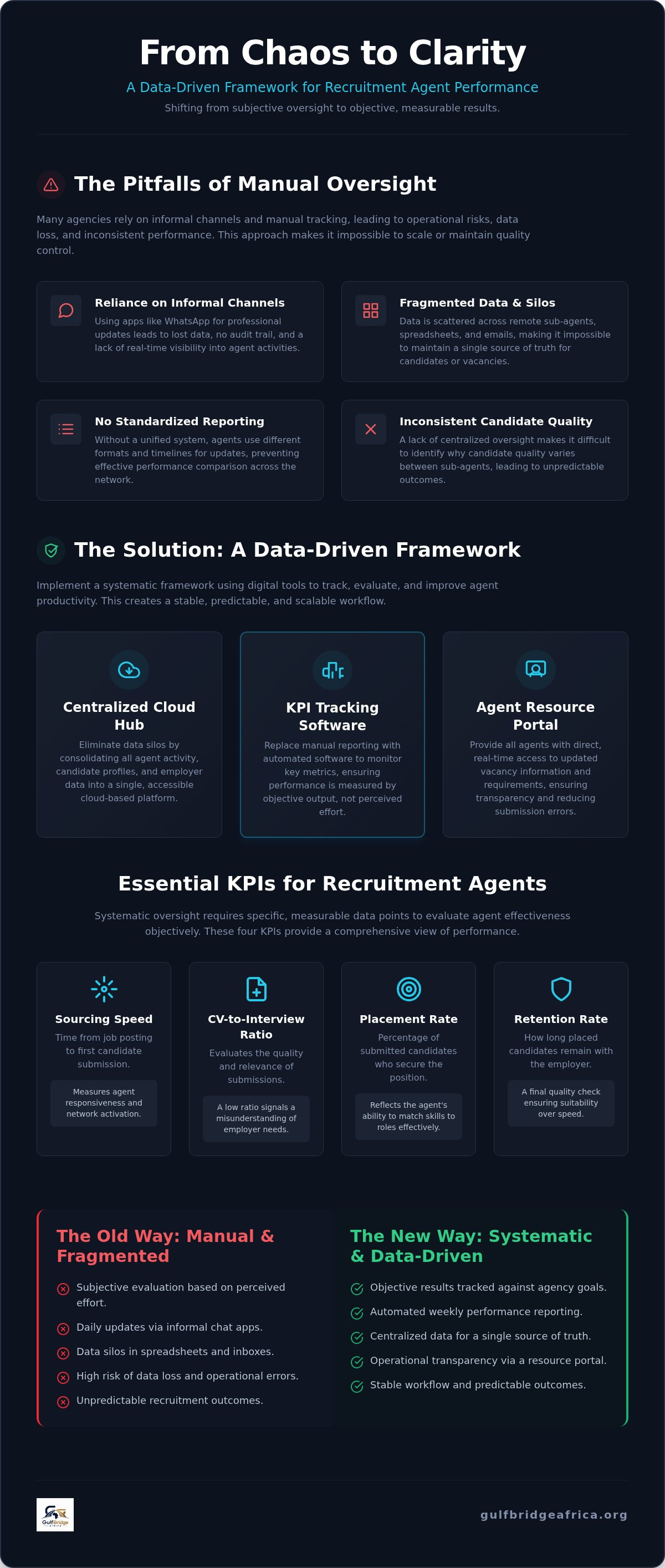
Managing recruitment agent performance is an operational data problem rather than a personality management task. Many agencies rely on informal channels like WhatsApp for daily updates. This reliance leads to data loss and a lack of real-time visibility into agent activities. When candidate quality becomes inconsistent across different sub-agents, the lack of a centralized system makes it difficult to identify the cause. Implementing recruitment agency KPI tracking software provides the necessary framework to monitor these activities with professional precision and administrative clarity.
You recognize that manual oversight is inefficient and often results in fragmented reporting. This guide provides the operational frameworks and digital tools required to track, evaluate, and improve recruitment agent productivity systematically. We will detail how to establish a centralized database for all recruitment activity and use an Agent Resource Portal to create transparency. You will learn to standardize agent reporting and improve candidate-to-placement ratios through structured data management. This systematic approach ensures your workflow remains stable and your recruitment outcomes remain predictable.
Key Takeaways
- Shift from subjective evaluation to objective results by tracking agent output against specific agency goals.
- Utilize recruitment agency KPI tracking software to monitor essential metrics like sourcing speed and CV-to-interview ratios.
- Centralize all recruitment data within a cloud-based hub to eliminate the operational risks associated with manual tracking and informal communication.
- Implement a structured review framework that combines clear onboarding expectations with automated weekly performance reporting.
- Maintain operational transparency by providing agents with direct access to updated vacancy information through a dedicated resource portal.
Defining Recruitment Agent Performance Management
Performance management is the systematic process of tracking agent output against agency goals. It shifts the focus from subjective effort to objective results through data tracking. This methodology ensures that every agent's contribution is measured by specific outcomes rather than perceived activity levels. Effective oversight requires a centralized database to monitor real-time progress across regions. Performance management is a baseline operational necessity for 2026 recruitment. Agencies use recruitment agency KPI tracking software to replace informal observation with structured data. This transition ensures that every agent action aligns with the broader organizational objectives.
The Role of Data in Agent Oversight
Transitioning from manual spreadsheets to automated data management systems improves accuracy. Manual entry often leads to data silos and human error. Automated systems provide real-time visibility into agent activity. This visibility reduces operational bottlenecks and delays by identifying stalled workflows immediately. Centralized data is essential for agency scaling and regional expansion across Africa. A cloud-based Employer Data Management Platform allows managers to oversee activities in multiple cities from a single interface. It provides a consistent framework for evaluating recruitment metrics across the entire team. Systematic data handling ensures that managers can identify top performers and those requiring additional training without bias. This objective approach builds a culture of accountability and professional reliability within the organization.
Common Performance Challenges in African Agencies
Many agencies struggle with fragmented data across multiple remote sub-agents in different cities. This fragmentation makes it difficult to maintain a single source of truth for candidate status or employer requirements. There's often a lack of standardized reporting in cross-border recruitment workflows. Without a unified system, agents use different formats and timelines for their updates. This inconsistency prevents effective performance comparison across the regional network. Reliance on informal communication channels like WhatsApp for professional data handling creates significant risks. Data is easily lost and can't be audited or analyzed for long-term trends. Using recruitment agency KPI tracking software centralizes these communications. It replaces informal chats with structured data points that support professional oversight. Utilizing an Agent Resource Portal ensures that all sub-agents have access to the same vacancy information. This reduces confusion and prevents the overlap of candidate submissions. Orderly data management is the only way to overcome the logistical hurdles of a distributed recruitment workforce.
Key Performance Indicators (KPIs) for Recruitment Agents
Operational success depends on the ability to measure recruitment metrics with precision. Systematic oversight requires specific data points to evaluate agent effectiveness across different jurisdictions. Recruitment agency KPI tracking software allows managers to capture these data points automatically. This ensures that performance reviews are based on objective output rather than anecdotal evidence. Without these metrics, agencies can't identify where a recruitment pipeline is failing or which agents require additional resources.
- Sourcing Speed: This tracks the time elapsed from a job posting to the first candidate submission. It measures the responsiveness of the agent to new vacancies and their ability to activate candidate networks quickly.
- CV-to-Interview Ratio: This metric evaluates the quality and relevance of agent submissions. A low ratio indicates that the agent doesn't understand specific employer requirements or is submitting unqualified profiles.
- Placement Rate: This is the percentage of submitted candidates who successfully secure positions. It reflects the agent's ability to match the right skills to the right roles effectively.
- Retention Rate: This monitors how long candidates remain with employers post-placement. It serves as a final quality control check to ensure agents aren't prioritizing speed over candidate suitability.
Quantitative vs. Qualitative Metrics
Tracking the number of calls and outreach attempts per day measures raw activity levels. High activity is necessary for pipeline growth but it's insufficient without accuracy. Managers must also evaluate the precision of candidate documentation and compliance with employer requirements. Incomplete or incorrect paperwork creates administrative delays and increases the risk of rejection. Balancing high-volume sourcing with specific skill matching is critical for specialized roles. Agents must ensure candidates meet exact technical and regulatory standards before submission. Utilizing an Agent Resource Portal helps agents maintain these standards by providing clear, updated job specifications in real time.
Setting Realistic Benchmarks for 2026
Establishing baseline performance targets requires a distinction between new and experienced recruitment agents. Experienced agents should meet higher placement quotas based on their established networks and market knowledge. Difficulty levels vary significantly by job vacancy and the specific African region targeted. Some markets require longer sourcing times due to talent scarcity or local logistical hurdles. Recruitment agency KPI tracking software uses historical data from your system to forecast future agent output and agency revenue. This data-driven forecasting allows agencies to project growth with greater accuracy. Analyzing past trends helps managers adjust benchmarks to reflect current market realities. This systematic approach ensures that targets remain challenging yet achievable for the entire team.
Evaluating Recruitment Agent Management Tools
Choosing the right oversight tools is a critical administrative decision. Manual tracking through Excel and WhatsApp poses significant operational risks. These informal channels lead to data fragmentation and lack a reliable audit trail. Managers can't easily track historical agent performance or candidate status using disconnected files. Centralizing all agent activity in a single operational hub ensures data integrity. Cloud-based recruitment agency KPI tracking software provides this centralized environment. It allows teams to share employer data securely without the risk of agent overlap. Cloud-based workforce management in Africa is the standard for 2026 due to its ability to synchronize remote teams across different regions.
Essential Features for Agency Oversight
Automated job posting portals facilitate rapid vacancy distribution to agent networks. This ensures all sub-agents receive the same information simultaneously. Agent resource portals allow for the efficient management of shared documents, flyers, and recruitment assets. This provides a consistent framework for performance management by ensuring agents use approved materials. Role-based access control is necessary to protect sensitive employer information. It prevents unauthorized data sharing by restricting access based on the agent's specific function. These features create a controlled environment where information flows only to the intended recipients.
Comparing Manual vs. SaaS Management
Manual data entry carries hidden costs including human error and lost candidate records. These errors delay placements and damage employer relationships. SaaS platforms eliminate these bottlenecks through automated data handling and centralized storage. Scalability is a primary benefit of modern systems. Understanding how manpower agency management software Africa supports agency growth is essential for long-term planning. These systems allow agencies to add new agents and regions without increasing administrative complexity. Security is another critical factor. Centralized cloud-based systems protect agency intellectual property from being exported or lost. Recruitment agency KPI tracking software ensures that all proprietary data remains within the agency's control. This systematic approach to tool evaluation leads to more stable and efficient recruitment operations.
Establishing a Systematic Performance Review Framework
Establishing a systematic performance review framework requires a shift from anecdotal observation to data-driven oversight. Managers must follow a structured process to ensure consistent agent output. This process begins with defining clear, data-backed expectations during the initial agent onboarding process. Implementing recruitment agency KPI tracking software provides the necessary infrastructure for this framework. It allows for the automation of performance data collection, ensuring that every review is based on objective reality. Managers don't need to guess which agents are underperforming when the system provides real-time visibility into every recruitment stage.
A standard review framework consists of five operational steps:
- Step 1: Define clear, data-backed expectations during the initial agent onboarding process to establish a baseline for success.
- Step 2: Implement weekly automated reporting to track real-time progress against established KPIs and identify immediate issues.
- Step 3: Conduct monthly performance reviews focused on data trends rather than anecdotes to maintain professional distance.
- Step 4: Provide targeted coaching based on specific pipeline bottlenecks identified in the system, such as low CV-to-interview ratios.
- Step 5: Reward high performers based on objective placement data and revenue generation to reinforce productive behaviors.
The Weekly Reporting Cycle
The weekly cycle focuses on immediate operational activity and pipeline health. Standard agent status reports should include specific data points such as the number of new candidate submissions, interview conversion rates, and pending documentation status. Agency management uses this report data to identify at-risk placements before they fail. For instance, if an agent has a high submission count but zero interviews, the system flags a quality bottleneck. This streamlines the feedback loop between agents and agency management, allowing for faster results. Consistent reporting ensures that every team member understands their current standing relative to their monthly targets without the need for manual follow-ups.
Coaching for Continuous Improvement
Coaching must remain objective and task-oriented to be effective. Managers use placement data to identify specific training needs such as sourcing techniques or candidate interview preparation. If the data shows a high interview-to-rejection rate, the coaching focuses on candidate briefing rather than sourcing volume. Implementing peer-to-peer knowledge sharing allows successful agents to document their strategies within the team environment. This maintains a professional, utilitarian approach to performance feedback. You can manage these review cycles and track performance history through an Employer Data Management Platform designed for systematic oversight. This centralized approach ensures that recruitment agency KPI tracking software remains the primary source of truth for all coaching sessions and performance evaluations.
Optimizing Agent Oversight with GulfBridge Africa
GulfBridge Africa provides a functional hub for managing regional recruitment data. It positions itself as a silent, reliable partner in your operational workflow. The platform eliminates guesswork by allowing you to track recruitment progress online in real time. This functionality improves agent accountability through transparent data access and standardized reporting. You can centralize your employer data management system to improve overall agent efficiency. This systematic approach ensures that every team member follows a consistent process. Using recruitment agency KPI tracking software within this framework creates an environment of professional reliability.
Centralized Data Management for Teams
The platform organizes multiple employer data types in one accessible location. It removes the need for fragmented communication across external messaging apps. Sharing digital flyers and recruitment assets through the Agent Resource Portal reduces redundant work across your team. Agents don't need to request documents manually or search through email threads. The portal ensures every team member has access to the latest vacancy info and job descriptions. This enables seamless collaboration across different African regions through secure cloud access. Secure data handling protects your agency's intellectual property while maintaining regional transparency. This structure supports the core functions of a high-performance agency by providing a clean, searchable data environment. Every action within the portal results in a clear organizational outcome for the manager.
Operational Efficiency and Scalability
Streamlining job postings allows your agency to reach agents and candidates faster across the African continent. Rapid vacancy distribution is essential for maintaining competitive placement speeds in high-demand markets. The platform features a professional, utilitarian interface designed for the specific needs of recruitment managers. It prioritizes clarity and operational efficiency over unnecessary visual flourishes or marketing hyperbole. This design mirrors the logic of a methodical guide to facilitate quick decision-making and rapid scanning. You can get started with a systematic approach to agency management by integrating your current agent lists into the GulfBridge Africa environment. The platform provides the necessary framework for professional data handling and cross-border team coordination. It scales with your agency as you expand into new cities and regions. This stability ensures that your oversight remains consistent and predictable regardless of your total agent count. The focus remains entirely on the utility of the platform and the success of your recruitment workflows.
Implementing Systematic Oversight for Recruitment Growth
Establishing a structured performance framework ensures that recruitment outcomes remain predictable and scalable. You've learned that effective oversight shifts the focus from subjective effort to objective, data-backed results. Tracking specific metrics such as sourcing speed and CV-to-interview ratios allows for the immediate identification of pipeline bottlenecks. Utilizing recruitment agency KPI tracking software centralizes these data points; this provides a single source of truth for your entire regional network. This administrative clarity prevents candidate overlap and ensures that all sub-agents follow standardized reporting protocols.
Operational stability depends on the tools you use to manage your remote teams. GulfBridge Africa offers a specialized platform for African manpower agencies. It provides cloud-based data centralization and an integrated agent resource portal to maintain documentation standards. These features work together to bring order to your professional environment. You can streamline your agency operations with GulfBridge Africa to achieve higher placement ratios and improved team accountability. Systematic management is the most reliable path to long-term recruitment success.
Frequently Asked Questions
What are the most important KPIs for a recruitment agent?
The most critical metrics include sourcing speed, CV-to-interview ratio, and placement rate. Sourcing speed measures the time elapsed from a vacancy posting to the first candidate submission. The CV-to-interview ratio evaluates candidate quality and alignment with employer requirements. Placement rate tracks the percentage of candidates successfully hired. These metrics provide objective data points for evaluating agent output and identifying specific pipeline bottlenecks within the recruitment workflow.
How often should I review my recruitment agents performance?
Performance reviews should follow a two-tier schedule consisting of weekly reporting and monthly deep-dives. Weekly reports track real-time progress against current job orders and identify immediate obstacles. Monthly reviews analyze long-term data trends and overall placement efficiency. This structured frequency ensures that managers maintain constant visibility into agent activities. Regular reviews allow for timely adjustments to sourcing strategies and ensure that agents remain aligned with agency goals.
Is it better to use Excel or a recruitment management system for tracking?
A dedicated recruitment management system is superior to Excel due to its ability to centralize data and provide real-time updates. Excel relies on manual entry which increases the risk of human error and data silos. Using recruitment agency KPI tracking software automates the collection of performance metrics and candidate status. This automation ensures data integrity and provides a secure audit trail that's difficult to maintain in fragmented spreadsheets.
How can I track the performance of remote agents in different African countries?
Tracking remote agents across borders requires a cloud-based Employer Data Management Platform. This system provides a centralized hub where agents from different regions input candidate data and status updates. Managers can monitor activities in multiple countries from a single interface without relying on informal communication channels. Secure cloud access ensures that all regional data is synchronized and accessible for performance evaluation regardless of the agent's physical location.
What should I do if a recruitment agent is consistently underperforming?
Address consistent underperformance by using system data to identify the specific stage where the agent is failing. Analyze metrics like low CV-to-interview ratios to determine if the issue is candidate quality or sourcing volume. Provide targeted coaching based on these objective findings rather than subjective observations. If performance doesn't improve after structured intervention, use the data trail to make an informed decision regarding the agent's role within the organization.
Can recruitment agent management tools help reduce time-to-hire?
These tools reduce time-to-hire by streamlining vacancy distribution and automating candidate status tracking. Centralized systems allow agents to access job details instantly through an Agent Resource Portal. This rapid access accelerates the sourcing phase and ensures that candidates are submitted more quickly. Automated alerts and real-time dashboards help managers identify and resolve delays in the interview process. Efficient data handling directly results in faster placement cycles across the entire agency.
How do I protect my employer data when using external sub-agents?
Protect employer data by implementing role-based access control within your management system. This feature restricts sub-agent access to only the specific information required for their assigned tasks. It prevents unauthorized data sharing and ensures that proprietary employer details remain within the agency's controlled environment. Centralized platforms provide a secure infrastructure for data handling. This approach minimizes the risk of data loss associated with using informal channels for professional communication.
What features should I look for in recruitment agency software for Africa?
Look for features like a cloud-based data management platform, an integrated agent resource portal, and automated job posting services. The software must support regional team coordination and provide secure access for remote sub-agents. Integrated recruitment agency KPI tracking software is essential for monitoring cross-border performance. Ensure the platform offers a utilitarian interface that prioritizes operational efficiency and clear data organization. These features provide the necessary framework for managing recruitment workflows across the African region.


